
The DPMCC Under Pressure — How the Strategy Performs in a Pullback
May 15, 2026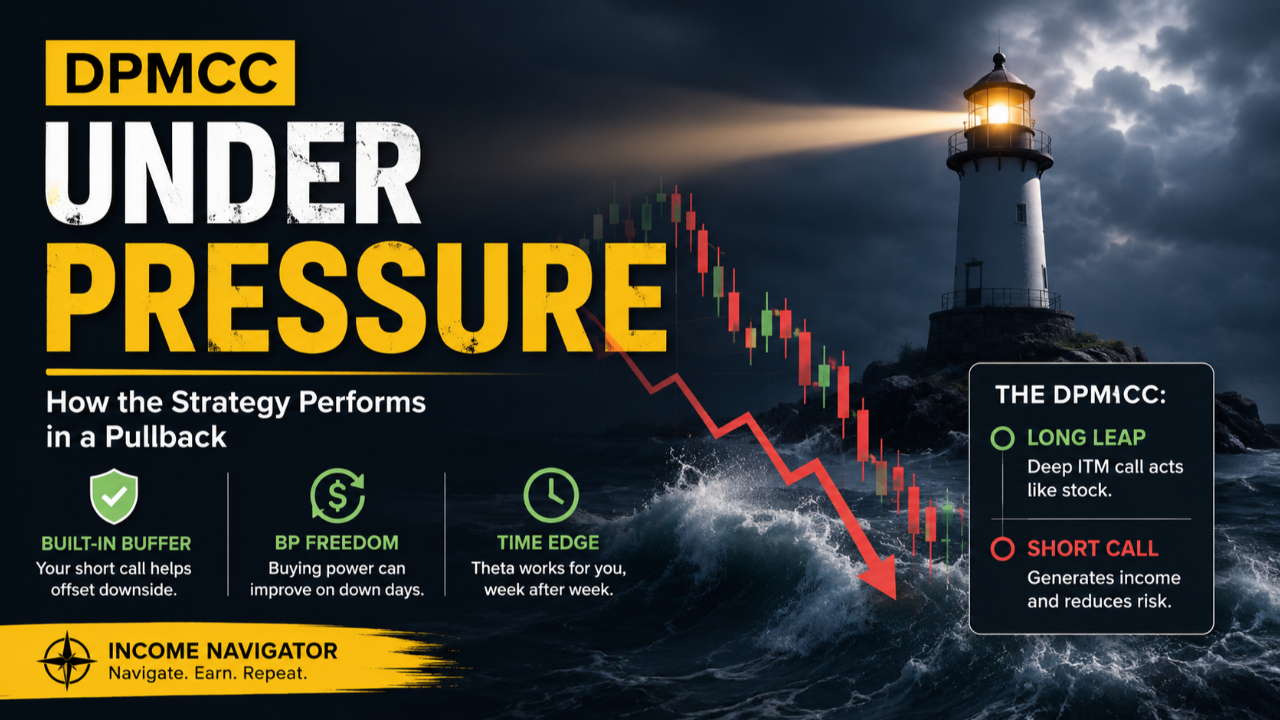
Today was one of those days.
Futures opened lower. Bond yields pushed higher. The market had just printed fresh all-time highs, and then suddenly the tone changed.
You know the type of day I'm talking about.
Everything feels calm for weeks, then one red day shows up and suddenly traders start staring at their P&L like something broke.
Inside our Discord this morning, I saw variations of the same question:
"My LEAP is dropping faster than my short call is helping. Is this normal? Am I doing something wrong?"
The answer is: yes, it's normal.
And understanding why is one of the most important parts of trading this strategy.
What's Actually Happening Under the Hood
The Dynamic Poor Man's Covered Call (DPMCC) is really just two moving pieces:
- A deep in-the-money LEAP call acting as your stock replacement
- A shorter-term call sold against it for income
When the market pulls back, both pieces react.
Your LEAP loses value because it carries substantial delta exposure. It behaves similarly to stock.
Your short call also loses value, which sounds bad at first — until you remember you're short that option.
When the option you sold declines in value, that's a gain for you.
This creates something many traders overlook:
The short call becomes your shock absorber.
It doesn't eliminate losses completely. Your LEAP will typically move more because of its larger directional exposure.
But instead of taking the full impact of the move like someone holding 100 shares outright, you're collecting premium that partially offsets that decline.
Think of it like driving over a pothole.
You still feel the bump.
You just don't destroy the suspension.
The Part That Usually Surprises Traders
One of the things newer DPMCC traders notice during pullbacks is something that initially feels backward:
Buying power may improve even while your P&L turns red.
Why?
Because notional exposure often decreases as the underlying pulls back.
Less exposure can mean less capital requirement.
That's one of the reasons I like framing risk through notional exposure rather than simply staring at buying power numbers.
When volatility rises and markets become unstable, many traders discover they suddenly have less flexibility than they thought.
The DPMCC often creates the opposite effect.
While others are being squeezed or forced into adjustments, you frequently gain room to operate.
Tom King summed it up perfectly in Discord this morning:
"Right now, everyone in this discord should be sitting on a sh#tload of BP."
That isn't an accident.
It's part of the design.
The Mistake I See Most Often
The biggest error during pullbacks isn't entering the trade.
It's reacting emotionally to it.
Trader sees red P&L.
Trader gets uncomfortable.
Trader closes the short call because they want to "reduce risk."
And that's where the process starts breaking down.
Your short call is the income engine.
Closing it prematurely often means removing the very component designed to help offset the decline.
A pullback day usually isn't a decision day.
It's a holding day.
Remember what the strategy is trying to accomplish:
The DPMCC isn't designed to make money because you're perfectly predicting market direction.
It's designed to systematically harvest extrinsic value over time.
You're letting theta do the heavy lifting.
One week.
Then another week.
Then another week.
That's where the edge lives.
When You Should Actually Start Paying Attention
Now this doesn't mean you blindly hold forever.
There are situations where reassessment matters.
A single red day?
Noise.
Two rough sessions?
Probably still noise.
What deserves attention is a sustained deterioration in the underlying:
- Lower highs
- Lower lows
- Weakening trend structure
- Significant changes in the original thesis
Over time, a prolonged decline can reduce the effectiveness of your LEAP and compress its delta exposure.
That's where management decisions begin becoming more important.
Until then, during ordinary pullbacks, the question usually isn't:
"How much am I down today?"
The better question is:
"Would I still want exposure to this underlying over the longer term?"
If the answer is yes, then often the best decision is simply allowing the strategy to do what it was built to do.
Final Thoughts
The DPMCC becomes uncomfortable at exactly the moments when traders are tempted to interfere with it.
That's normal.
Strategies always look easiest on green days.
The real test happens during the days where you start questioning whether the process still works.
Understanding why the position behaves the way it does is what separates traders who stay disciplined from traders who panic out at the worst possible time.
Because in many cases, the pullback wasn't the problem.
The reaction was.
Want the Full DPMCC Playbook?
If you want to go deeper into:
- Strike selection
- Rolling mechanics
- Managing through different volatility regimes
- Position sizing and portfolio construction
- Real trade examples and management rules
Check out the DPMCC course at: Income Navigator DPMCC Course
Income Navigator is an options trading education platform focused on income-generating strategies for self-directed investors. This material is for educational purposes only and should not be considered financial advice.
Stay connected with news and updates!
Join our mailing list to receive the latest news and updates from our team.
Don't worry, your information will not be shared.
We hate SPAM. We will never sell your information, for any reason.
