
Why a High Win Rate Can Be Dangerous
Jul 12, 2026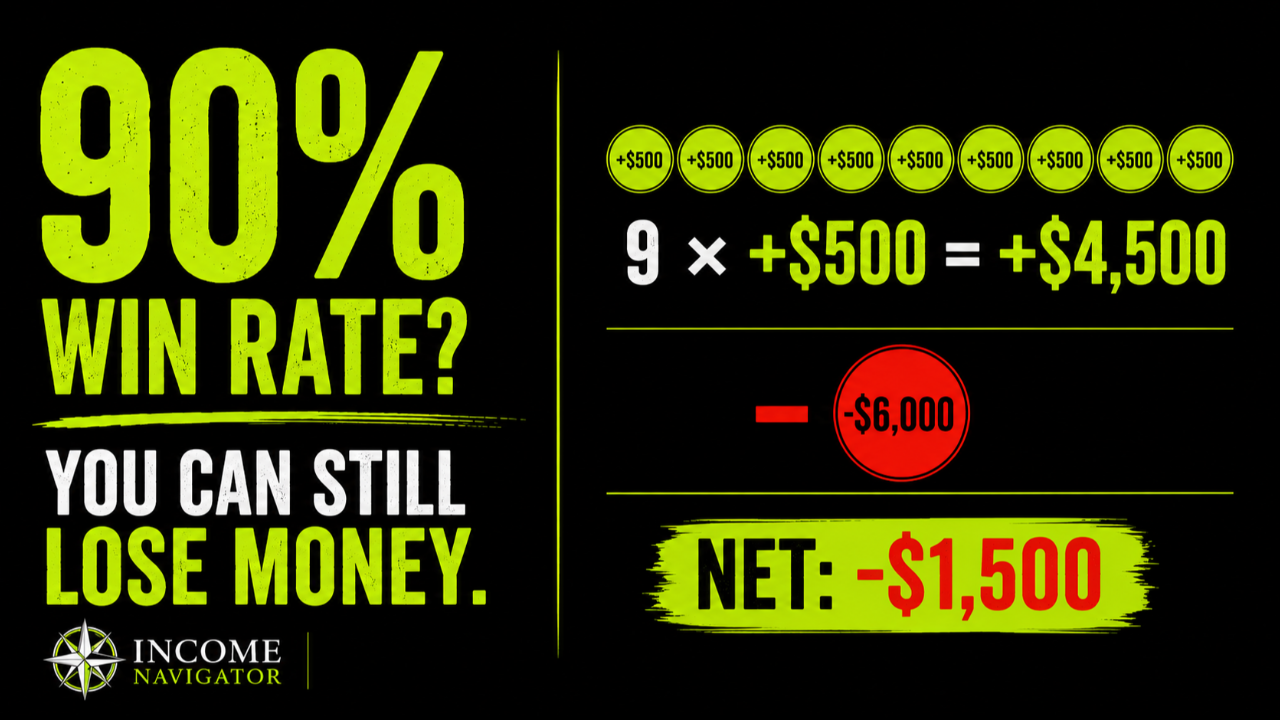
What's your win rate?
It's one of the first statistics traders like to talk about.
70% sounds good.
80% sounds even better.
90% sounds incredible.
But there's a problem.
A high win rate doesn't necessarily mean you're making money.
In fact, some of the most dangerous trading strategies can produce extremely high win rates right up until the loss that changes everything.
90% Winners Can Still Lose Money
Let's keep the math simple.
You make ten trades.
Nine of them make $500 each.
That's:
9 × $500 = $4,500
You're winning 90% of your trades.
Then trade number ten loses $6,000.
Your result?
-$1,500.
You were right nine times out of ten and still lost money.
That's why I wrote in The Difference Between Being Wrong and Losing Too Much that being right isn't the objective.
What happens when you're wrong matters just as much.
Options Selling Can Create This Illusion
This is especially important for options sellers.
Many premium-selling strategies naturally produce frequent winners.
Time decay works in your favor.
The underlying doesn't always need to move in the direction you predicted.
And depending on the strategy, you may be able to profit if the market moves sideways or even somewhat against you.
That can produce a very attractive win rate.
But a high win rate can hide something important:
How large is the occasional loser?
If you consistently collect $300 or $500 but periodically lose several thousand dollars, counting winners tells you very little about whether the strategy actually has an edge.
Winning Often Can Make You Take More Risk
There's also a psychological problem.
The more frequently a strategy wins, the safer it can begin to feel.
You sell premium.
It expires worthless.
You do it again.
Another winner.
After ten, twenty or thirty successful trades, confidence grows.
And sometimes position size grows with it.
"This strategy works."
"I can probably add another contract."
"Why am I leaving all this buying power unused?"
That's when a high win rate can become dangerous.
You're often taking the largest positions precisely when you've become least concerned about the risk.
Then the Outlier Arrives
Markets have a way of eventually producing something outside the recent experience.
A volatility shock.
A large overnight move.
An unexpected headline.
A correlation breakdown.
Something happens that your last twenty winning trades didn't prepare you for.
Now the position that usually makes $500 is down $2,000.
Then $4,000.
Then $6,000.
And because you've become accustomed to winning, taking the loss feels almost impossible.
You tell yourself the trade usually comes back.
Maybe you move the stop.
Maybe you add size.
Maybe you roll simply because you don't want to realize the loss.
This is where being too big to take the loss can turn one bad trade into a portfolio problem.
Win Rate Without Average Win and Average Loss Is Meaningless
If someone tells me a strategy has an 85% win rate, that number alone doesn't tell me very much.
I also want to know:
- What's the average winner?
- What's the average loser?
- What's the largest historical loss?
- How frequently do those larger losses occur?
- How much capital is required?
- How does the strategy behave during a volatility event?
Those numbers begin to tell us something about the actual economics of the strategy.
Think in Expected Value, Not Just Win Rate
A better way to evaluate a strategy is to consider both the probability and magnitude of its outcomes.
Suppose a strategy wins 80% of the time.
The average winner is $500 and the average loser is $1,000.
Over 100 hypothetical trades:
80 winners × $500 = $40,000
20 losers × $1,000 = -$20,000
That's a positive result.
Now keep the exact same 80% win rate but change the average loss to $2,500.
80 winners × $500 = $40,000
20 losers × $2,500 = -$50,000
Same win rate.
Completely different strategy.
The payoff distribution changed everything.
High Probability Doesn't Mean Low Risk
This is another distinction options traders need to understand.
A high-probability trade is not automatically a low-risk trade.
Sometimes it's exactly the opposite.
You may be accepting a high probability of making a relatively small amount of money in exchange for a lower probability of experiencing a much larger loss.
Neither structure is inherently good or bad.
But you need to understand the trade you're making.
Probability tells you how often an outcome may occur.
Risk tells you what happens when it does.
Don't Optimize Your Trading for Bragging Rights
A 90% win rate sounds impressive.
It looks great in a screenshot.
It feels good psychologically.
But your brokerage account doesn't care how many trades you won.
It cares about dollars gained versus dollars lost.
I'd rather have a sustainable strategy with a lower win rate and controlled losses than a 95% win rate that exposes the portfolio to occasional catastrophic drawdowns.
The goal isn't to win the most trades.
The goal is to build a process that makes money while keeping losses survivable.
See How We Think About Risk in Real Trades
Win rate is only one piece of the puzzle.
Inside Income Navigator, we focus on the entire trade — probability, position size, risk, adjustments, exits and how each position fits into the overall portfolio.
You'll see the trades we're taking inside our Discord community, but more importantly, you'll see the thinking and risk management behind them.
If you'd like to see how we put those concepts into practice:
Stay connected with news and updates!
Join our mailing list to receive the latest news and updates from our team.
Don't worry, your information will not be shared.
We hate SPAM. We will never sell your information, for any reason.
