
The Difference Between Being Wrong and Losing Too Much
Jul 10, 2026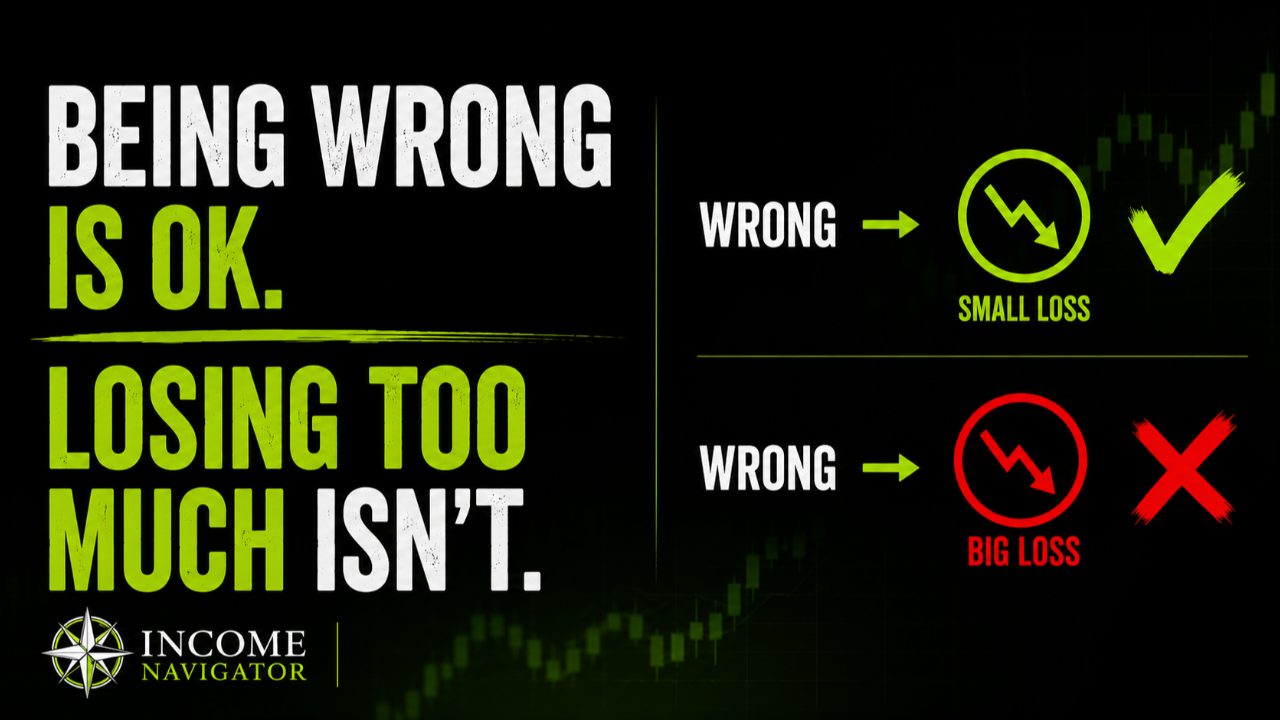
You're going to be wrong.
If you trade long enough, there's no way around it.
You'll be bullish right before the market drops.
You'll sell premium before volatility expands.
You'll enter what looks like a great setup and watch it immediately move against you.
That's trading.
But there's an important distinction that traders often miss:
Being wrong and losing too much are not the same thing.
You can't completely control how often you're wrong.
You have much more control over what happens to your portfolio when you are.
Your Job Isn't to Be Right All the Time
A lot of traders approach the market as if their primary objective is to be right.
They want to predict the next move.
They want a high win rate.
They want every position to work.
But profitable trading doesn't require you to be right all the time.
It requires you to understand the relationship between your winners and your losers.
A trader can be right 80% of the time and still lose money.
Another trader can be right 50% of the time and make money.
The difference is what happens when they're wrong.
A Loss Should Be an Expected Event
Before you enter a trade, you should already accept that it may lose.
Not intellectually.
Financially.
If your planned loss is $500, you should be able to experience that $500 loss without it materially affecting your portfolio or changing your behavior.
That's why position sizing matters so much.
As I discussed in Your Position Size Changes Your Psychology, the exact same trade can produce completely different behavior depending on how large you make it.
The loss shouldn't become an emergency simply because it actually happened.
The Problem Starts When Being Wrong Becomes Unacceptable
Suppose you enter a trade and plan to exit at a $500 loss.
The trade moves against you.
You're wrong.
Nothing unusual has happened yet.
But instead of taking the loss, you decide to wait.
$500 becomes $750.
$750 becomes $1,200.
$1,200 becomes $2,000.
At that point, the problem isn't that your market opinion was wrong.
The problem is that you allowed being wrong to become expensive.
This is exactly why the trade you couldn't take a stop on was probably too big.
Small Losses Are Part of the Business
Professional traders don't eliminate losses.
They build losses into the business model.
Think about any other business.
A retailer has damaged inventory.
A restaurant has food waste.
An insurance company pays claims.
Those costs aren't necessarily evidence that the business is failing.
They're expected expenses of operating the business.
Trading losses should be viewed similarly.
A controlled loss is a cost of doing business.
A catastrophic loss is something different.
One Big Loss Can Undo a Lot of Good Trading
Imagine you make $500 on ten trades.
That's $5,000.
Then one position gets away from you and loses $6,000.
You were profitable on 10 out of 11 trades.
Your win rate was more than 90%.
And you still lost money.
This is why I don't obsess over win rate.
How much you make when you're right and how much you lose when you're wrong matters far more than simply counting winners.
This is also why a strategy that produces frequent small winners can sometimes be more dangerous than it appears.
We'll explore that in the next article.
Don't Judge Yourself for Being Wrong
There's another reason this distinction matters.
If you believe every losing trade represents a failure, you'll naturally start trying to avoid taking losses.
You'll hold positions longer.
You'll move stops.
You'll roll trades simply to avoid realizing a loss.
You'll turn risk management decisions into attempts to prove that your original prediction was correct.
That's dangerous.
A trade doesn't know what price you entered.
And your portfolio doesn't care whether your market prediction eventually turns out to be right.
Your portfolio only experiences the P&L.
A Good Trade Can Still Be Wrong
You can make a perfectly reasonable trading decision and still lose.
That's the nature of probability.
I covered this in A Good Trade Can Still Lose Money.
If the setup made sense, the risk was appropriate, the position was sized correctly and you followed your plan, a losing outcome doesn't automatically make the decision bad.
The objective isn't to eliminate those losses.
It's to make sure they're small enough that you can continue executing the strategy.
Define the Consequence Before You Enter
Before entering your next trade, don't just ask:
"How much can I make?"
Ask:
"What happens if I'm wrong?"
How much can the position lose?
What does that loss represent as a percentage of the portfolio?
What happens if several positions lose simultaneously?
Can you take the loss without changing your behavior?
Can you take another trade tomorrow?
If you can answer those questions before entering, being wrong becomes much less important.
Control What You Can Control
You can't control tomorrow's market direction.
You can't control volatility.
You can't control the next economic report, earnings surprise or unexpected headline.
But you can control:
- How large you trade.
- How much exposure you carry.
- Where you reduce risk.
- How much you're willing to lose.
- Whether one bad trade can materially damage your portfolio.
Being wrong is part of trading.
Losing too much when you're wrong doesn't have to be.
Once you understand that distinction, you stop trying to build a trading process that never loses.
You start building one that can survive losses.
See How We Manage Risk in Real Trades
Risk management makes a lot more sense when you can see it applied to actual positions.
Inside Income Navigator, we share the trades we're taking and, more importantly, the thinking behind them — position sizing, entries, adjustments, exits and portfolio risk.
The goal isn't to blindly copy trades. It's to understand how experienced traders make decisions when positions are working and when they're not.
If you'd like to follow the trades and join the discussion inside our Discord community:
Stay connected with news and updates!
Join our mailing list to receive the latest news and updates from our team.
Don't worry, your information will not be shared.
We hate SPAM. We will never sell your information, for any reason.
