
Trading Psychology: Why a Winning Trade Can Still Be a Bad Trade
Jun 25, 2026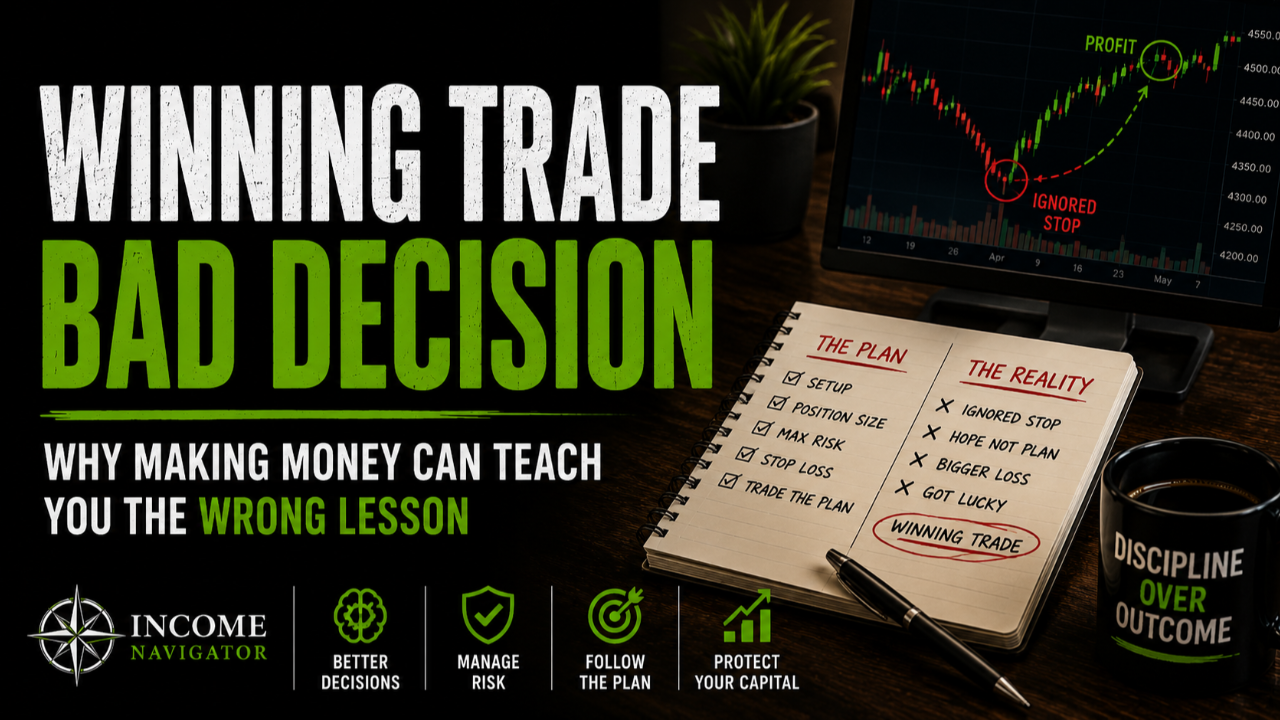
One of the most dangerous things that can happen to a trader isn't losing money.
It's making money while doing something you shouldn't have done.
That sounds backwards.
After all, we're trading to make money.
But there's a big difference between making money on a trade and making a good trading decision.
Understanding that difference is one of the most important lessons in trading psychology and risk management.
When the Market Rewards a Bad Decision
Here's a situation I've seen countless times.
You enter a trade with a plan.
You know where you'll manage it. You know how much you're willing to lose. You know what would tell you the trade isn't working.
Then the position moves against you.
Eventually, it reaches the point where your risk management plan says it's time to get out.
But you don't.
Maybe you don't want to take the loss.
Maybe you think the market is about to reverse.
Maybe you tell yourself you'll just give it one more day.
Then the market turns around.
The position recovers.
You eventually close the trade for a profit.
It feels like a win.
But something much more important just happened.
The market rewarded you for breaking your own rules.
That's where the real danger begins.
The Wrong Lesson From a Winning Trade
The next time a position moves against you, your brain remembers what happened before.
"Last time I waited, it came back."
So you ignore the exit again.
Maybe that trade comes back too.
Now you've been rewarded twice.
Before long, you start believing that taking a stop is unnecessary because the market usually gives you another chance.
Until you get the trade that doesn't.
The position keeps moving against you.
A planned $500 loss becomes $1,000.
Then $2,000.
Then something even more dangerous happens.
The larger the loss becomes, the harder it becomes psychologically to close the trade.
At that point, you're no longer managing the position.
You're hoping.
A Winning Trade Can Still Be a Bad Trade
This is why I don't judge the quality of a trade solely by whether it made or lost money.
Consider two traders.
Trader A enters a position, sizes it correctly, defines the risk, and follows the plan.
The trade doesn't work.
Trader A exits at a $500 loss.
Trader B enters a similar position.
The trade reaches the same $500 loss, but Trader B refuses to close it.
The loss grows to $1,500.
Then the market reverses.
Trader B eventually exits with a $300 profit.
Who made the better trade?
Most people naturally want to say Trader B.
Trader B made money.
Trader A lost money.
But from a process standpoint, Trader A may have made the far better decision.
Trader A controlled the risk.
Trader B abandoned the plan and happened to get rescued by the market.
That's not the same thing as good trading.
Don't Confuse Outcome With Decision Quality
Trading is a probability-based business.
That means individual outcomes can be misleading.
A great setup can lose.
A terrible setup can win.
You can follow every rule and still have a losing trade.
You can break every rule and somehow make money.
One trade doesn't prove much.
What matters is whether the process you're following can be repeated over hundreds of trades.
Ask yourself:
- Did I have a valid reason for entering?
- Was the position sized appropriately?
- Did I understand the risk before entering?
- Did I know what would cause me to exit or adjust?
- Did I actually follow the plan?
Those questions tell you far more about the quality of your trading than whether the P&L happened to be green at the end.
Why Risk Management Exists
Risk management isn't there to prevent losing trades.
That's impossible.
Risk management exists to prevent an ordinary losing trade from becoming a portfolio problem.
You're going to have losses.
You're going to have trades that don't behave the way you expected.
You're going to be wrong.
That's part of the business.
The goal isn't to eliminate those situations.
The goal is to make sure you can survive them.
This becomes even more important with options because leverage, volatility, gamma, and changing buying-power requirements can cause risk to expand much faster than many traders expect.
A position that feels manageable when you enter it can look completely different after a large move in the underlying.
That's why the important risk decisions need to be made before the trade becomes emotional.
The Market Will Occasionally Reward Bad Behavior
This is something every trader needs to understand.
The market will occasionally reward you for doing the wrong thing.
You can trade too large and make money.
You can ignore a stop and watch the position recover.
You can chase a stock and catch the exact bottom.
You can break every rule in your trading plan and have one of your best days of the year.
Don't confuse that outcome with evidence that the behavior was correct.
Because the danger isn't what happens that day.
The danger is that you repeat the behavior because it worked.
Eventually, you'll run into the trade that doesn't recover.
And one badly managed position can erase the profits from dozens of properly managed trades.
Judge the Process, Not Just the P&L
A profitable trade isn't automatically a good trade.
A losing trade isn't automatically a bad trade.
The better question is:
Did I make a decision that I would be comfortable repeating hundreds of times?
If the answer is yes, you're building a process.
If the answer is no, the fact that the trade made money shouldn't make you feel better about it.
Because the goal isn't to get lucky on one trade.
It's to stay in the game long enough for a repeatable edge to work.
The market will occasionally reward bad decisions.
Don't let it teach you the wrong lesson.
Want to Become a More Disciplined Trader?
Strategies matter.
But understanding risk, position sizing, portfolio management, and how to make better trading decisions matters even more.
That's what we focus on inside Income Navigator.
Stay connected with news and updates!
Join our mailing list to receive the latest news and updates from our team.
Don't worry, your information will not be shared.
We hate SPAM. We will never sell your information, for any reason.
