
When Should You Roll a Cash-Secured Put?
Sep 12, 2026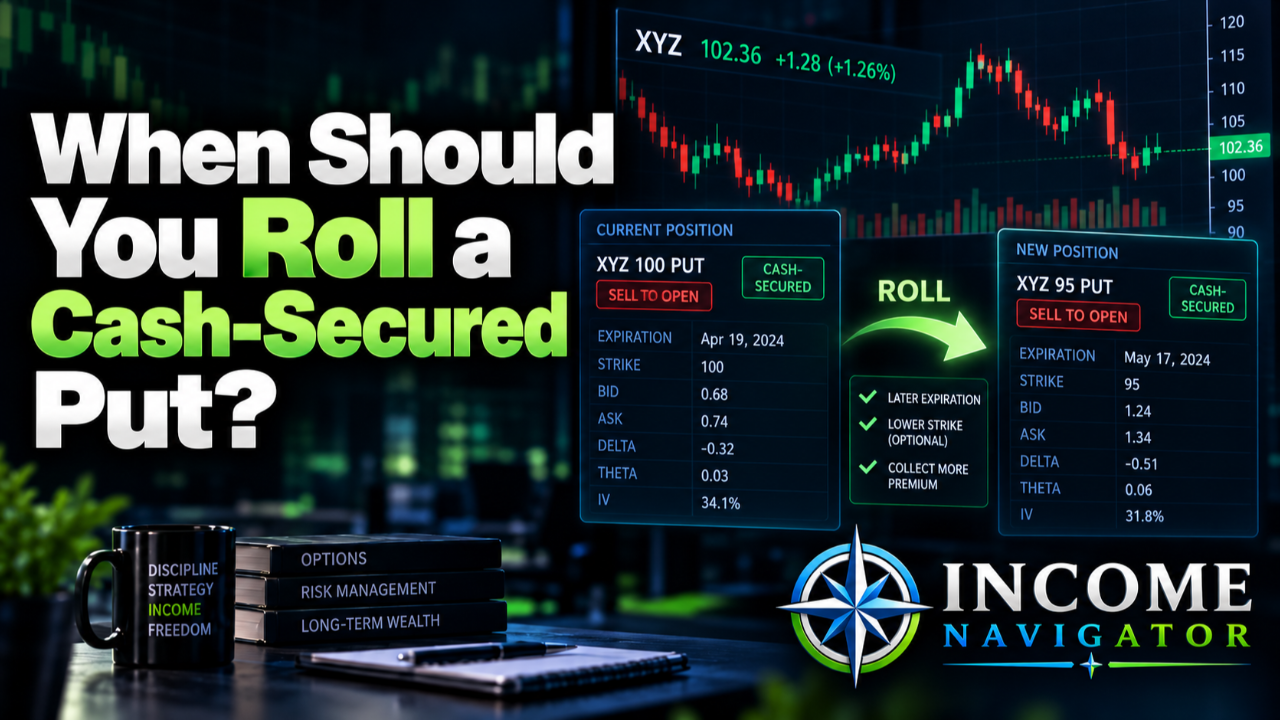
A cash-secured put moves against you.
The stock falls.
The option moves in the money.
Expiration is getting closer.
And eventually, nearly every trader asks the same question:
Rolling is one of the most common management tools in options trading.
It can extend the duration of a position.
It can move the strike.
It can collect additional premium.
And sometimes, it can turn an uncomfortable short put into a more manageable position.
But rolling is not a solution simply because a trade is losing.
It does not make a bad stock better.
It does not make an oversized position smaller.
And it does not eliminate the obligation you accepted when you sold the put.
Rolling is not a way to avoid a decision. It is a new trade decision.
What Does It Mean to Roll a Cash-Secured Put?
Rolling a cash-secured put means closing the current short put and opening a new short put at the same time.
The new put may have a later expiration date.
It may use the same strike.
It may use a lower strike.
Or it may combine a new expiration with a different strike price.
For example, imagine you sold a $50 put that is now in the money.
You might buy back the current contract and sell a new $50 put with a later expiration.
Or you might buy back the $50 put and sell a $47.50 put in a later cycle.
In either case, you are not making the original trade disappear.
You are closing one position and entering another.
You close the existing put.
You open a new put.
The new trade should stand on its own.
That is the key idea.
Do not think about the roll only as an extension of the old trade.
Evaluate it as if you were deciding whether to sell the new put for the first time today.
The First Question Is Not “Can I Roll?”
Most short puts can be rolled.
The better question is:
If the answer is no, rolling may not make sense.
Maybe you no longer want to own the stock.
Maybe the position is too large.
Maybe the stock has changed in a way that no longer fits your plan.
Maybe the premium available does not justify extending the obligation.
Or maybe you are simply trying to avoid admitting that the original trade did not work.
That is where traders can get into trouble.
They stop evaluating the stock and start managing the discomfort.
They roll because the loss feels hard to accept.
They roll because assignment feels like failure.
They roll because they want more time.
But more time is not automatically more edge.
Sometimes, it is simply more exposure.
📖 Related Reading
Assignment is not automatically a failed trade.
Before rolling only to avoid assignment, understand what assignment actually means and why stock ownership can be an acceptable outcome when it was part of the plan.
When Rolling May Make Sense
Rolling can make sense when the new trade still fits your plan.
That usually means several things are true at the same time.
- You still want exposure to the underlying stock.
- You would still be comfortable owning shares at the new strike price.
- The position size remains appropriate for your portfolio.
- The new expiration gives you a reasonable tradeoff between time, premium, and risk.
- The premium received for the new put justifies extending the obligation.
- You are making the decision from a process, not simply from discomfort.
Rolling can be useful when it gives you a better version of a trade you would still want to make.
For example, if you remain comfortable with the stock but can move the strike lower and extend the expiration while receiving enough credit to justify the change, the roll may improve the structure of the position.
But the point is not to keep the trade alive at any cost.
The point is to decide whether the new position is worth owning.
When Rolling Does Not Make Sense
Rolling may not make sense when you no longer want the stock.
It may not make sense when the position is already too large.
It may not make sense when the new premium is too small to justify extending the risk.
And it may not make sense when you are using a roll as a way to delay a decision you already know needs to be made.
Here are several warning signs:
- You would not sell the new put if you had no existing trade.
- You are only rolling because you do not want to realize a loss.
- You no longer want to own the stock at the new strike.
- The position already creates too much exposure in your portfolio.
- The stock’s outlook has changed in a way that no longer fits your original plan.
- The available credit does not adequately compensate you for more time and risk.
Rolling is not automatically disciplined.
Sometimes discipline means accepting assignment.
Sometimes it means closing the trade.
And sometimes it means rolling into a structure that genuinely fits the plan better.
The right action depends on the new decision—not the old hope.
Rolling for Time Versus Rolling Down
There are different ways to roll a put.
Each one changes the position differently.
Rolling Out
Rolling out means closing the current put and selling a new put with a later expiration date, often at the same strike.
This gives the stock more time to recover or stabilize.
But it also extends the duration of the obligation.
Rolling Down and Out
Rolling down and out means closing the current put and selling a new put with a lower strike and a later expiration.
This may reduce the eventual purchase price if assigned.
But it may also require more time, may produce less premium, or may not be available for a meaningful credit depending on the market.
Rolling In
Rolling in means moving the strike closer to the current stock price. It may increase the premium collected, but it also increases the potential purchase price and assignment risk. That is not automatically a better adjustment simply because the credit is larger.
The language can sound technical.
But the decision is still simple.
Are you improving the terms of a trade you still want?
Or are you increasing risk because you do not want to deal with the original outcome?
Do Not Let a Credit Make the Decision for You
Traders often focus on whether they can roll for a credit.
A credit can feel like proof that the adjustment is working.
But a credit does not make the new trade automatically better.
You may receive a credit because you extended the trade for more time.
You may receive a credit because you accepted a strike that creates more risk.
You may receive a credit because implied volatility is elevated.
The question is not simply whether the roll produces more premium.
The question is whether the additional premium is enough to compensate you for the additional obligation.
📖 Related Reading
High premium can mean the market sees more risk.
A larger credit may look attractive, but it can also reflect greater uncertainty, wider expected movement, or elevated implied volatility.
Read High IV Options: Why Higher Premium Means Higher Risk →
Position Size Still Comes First
Rolling does not change the fact that a cash-secured put can represent a meaningful stock-purchase obligation.
It may change the expiration.
It may change the strike.
But it does not eliminate the need to think about the total position size.
If the original trade was too large, rolling it may simply keep an oversized position open for longer.
Before rolling, consider:
- How much capital will still be committed after the roll?
- Would assignment at the new strike create too much stock exposure?
- Do you have other positions exposed to the same stock, sector, or market theme?
- Will extending the trade reduce your flexibility for other opportunities?
A roll can be reasonable.
But it should not be used to ignore concentration, correlation, or buying-power pressure.
📖 Related Reading
Position size changes the management decision.
A roll may look manageable on the option chain, but the real question is whether the stock exposure behind the new position fits the portfolio.
Read Position Sizing: How Trade Size Changes Your Psychology →
A Simple Rolling Checklist
Before rolling a cash-secured put, ask:
- Would I sell this new put today if I did not already have a position?
- Do I still want to own the stock at the new strike?
- Does the new expiration give me a reasonable tradeoff between time and risk?
- Does the premium received justify extending the obligation?
- Is the position size still appropriate for my portfolio?
- Am I rolling because the trade still fits my plan, or because I do not want to take a loss?
- What is my plan if the stock continues to fall after I roll?
If you cannot answer those questions clearly, rolling may not be the best decision.
Rolling Is a New Decision
Rolling a cash-secured put can be useful.
It can give a trade more time.
It can move the strike.
It can collect additional premium.
But none of those things make the roll automatically right.
The only question that matters is whether the new position is one you would choose to open today.
If it is, the roll may be a reasonable way to manage the trade.
If it is not, more time may simply create more exposure.
Roll only when the new trade still deserves to exist.
Learn to Think Beyond the Trade
At Income Navigator, we do not focus on chasing the highest premium or blindly following trade alerts.
We focus on understanding the structure of the trade, the risk being taken, position sizing, volatility, portfolio exposure, and how each position fits within an overall trading plan.
Inside the Income Navigator community, members can follow real options trades and see the thinking behind entries, adjustments, exits, and risk-management decisions as they happen.
If you want to build a more disciplined approach to options trading instead of simply chasing premium, learn more about Income Navigator here.
Options education, real-world trade management, and a community focused on the process behind the trade.
Options trading involves substantial risk of loss and is not appropriate for all investors. Past performance is not indicative of future results. This content is for educational purposes only and should not be considered investment, legal, or tax advice.
Stay connected with news and updates!
Join our mailing list to receive the latest news and updates from our team.
Don't worry, your information will not be shared.
We hate SPAM. We will never sell your information, for any reason.
