
What Delta Actually Tells You (And What Most Traders Get Wrong)
May 16, 2026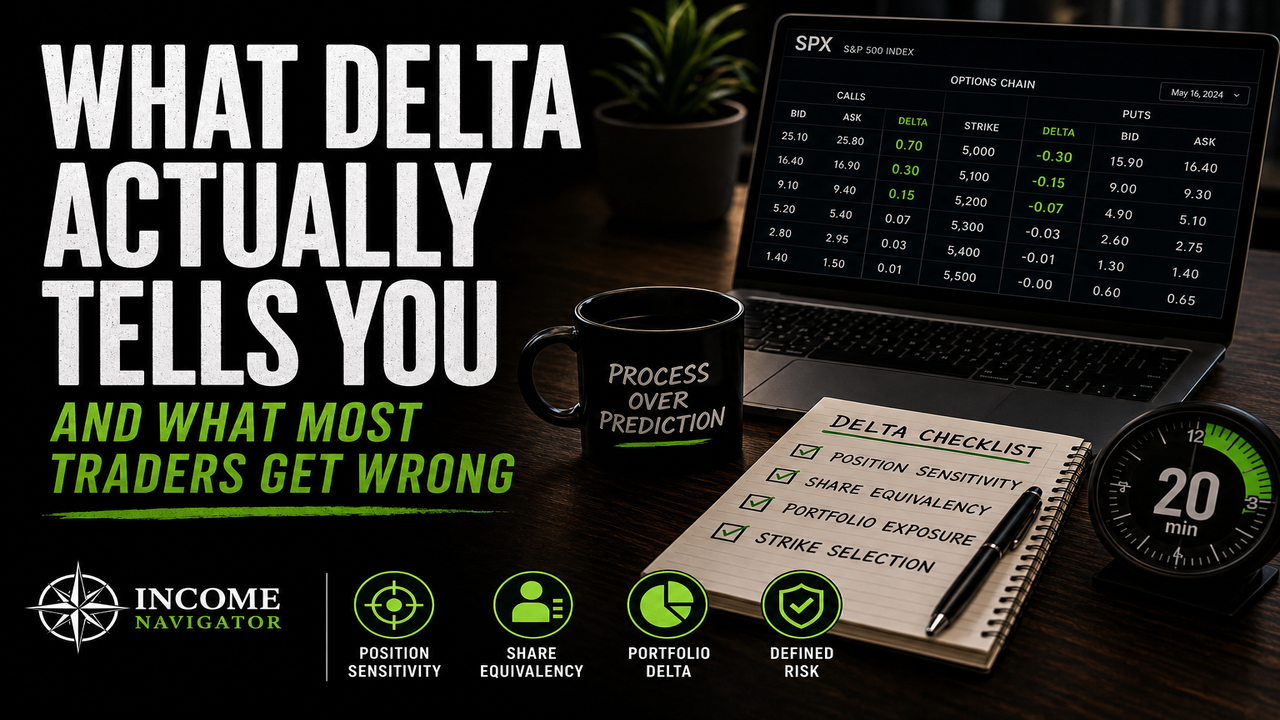
What Delta Actually Tells You (And What Most Traders Get Wrong)
Delta gets thrown around constantly in options education.
"Sell the 0.30 delta call." "Buy the 0.70 delta LEAP."
Everyone nods like they understand it.
Most don't. Not really.
They know the shortcut — delta ≈ probability of expiring in the money.
They use it to pick strikes and move on.
That's not wrong exactly, but it's incomplete.
And incomplete understanding leads to decisions that blow up positions you thought were safe.
Let me tell you what delta actually tells you, and more importantly, how to use it like a trader instead of a textbook reader.
Delta Is Rate of Change, Not a Probability Score
Here's what delta actually measures: how much your option's price moves for every $1 the underlying moves.
That's it. No formula required.
A 0.30 delta call on SPY gains roughly $0.30 for every $1 SPY moves up.
A 0.70 delta call gains roughly $0.70. The number is telling you the option's sensitivity to stock movement — right now, at this moment.
The probability interpretation is a useful by-product of that number, not the definition.
An option with a 0.30 delta does roughly correspond to a 30% chance of expiring in the money.
That's a handy mental shortcut for strike selection.
But when traders anchor entirely on probability and forget about sensitivity, they start making mistakes.
The Probability Trap
Here's where I see traders go wrong most often.
Someone sells a 0.20 delta put on AAPL.
They tell themselves it only has a 20% chance of finishing in the money.
They feel good about it. Then AAPL drops 8% in a week and they're watching that "safe" put double or triple in price, wondering what happened.
What happened is delta wasn't standing still.
A 0.20 delta put at the time of entry can quickly become a 0.40 or 0.50 delta put as the stock falls.
The probability framing gave them false confidence.
They thought about their strike.
They forgot to think about how the position behaves as the trade moves against them.
The Better Mental Model: Position Sensitivity
Stop thinking about delta as a probability.
Start thinking about it as share equivalency.
A 0.30 delta option on 1 contract controls 100 shares.
So your effective exposure is like owning 30 shares. That's your position delta.
Now scale it up. You're running 10 contracts at 0.30 delta.
That means your position behaves like 300 shares of that stock.
If SPY moves $2, your combined position moves roughly $600. Not in your favor if you're wrong about direction.
This is the mental model that actually matters for income traders managing real positions across a portfolio.
Portfolio delta — the sum of all your delta exposures — tells you your total effective equity exposure right now.
If your account holds positions that add up to 2,000 deltas long across SPY, SPX, AAPL, and a handful of other names, you essentially have the directional exposure of 2,000 shares of stock.
In a flat-to-up market, great. In a sharp sell-off, you feel every point of that exposure.
Most traders have no idea what their portfolio delta is. That's a risk management problem, not just a theoretical one.
Delta Moves — That's the Part People Miss
Delta at entry is not delta at expiration. Not even close.
As a trade moves in or out of the money, delta shifts.
That shift is driven by gamma — the rate of change of delta itself. I'm not going to go deep on gamma here, but you need to understand this: delta is a snapshot, not a fixed number.
A short call that's comfortably out of the money at 0.25 delta when you enter can become a 0.50 or 0.60 delta problem if the stock runs up 10%.
Now your short call is moving almost dollar-for-dollar against you. Your position risk has changed dramatically even though you haven't touched the trade.
This is why managing by delta target — not just entry delta — matters.
When my short call delta drifts too far, that's a signal to act.
Not because I'm wrong about direction necessarily, but because my position is now behaving differently than I designed it to behave.
How We Use Delta in the DPMCC
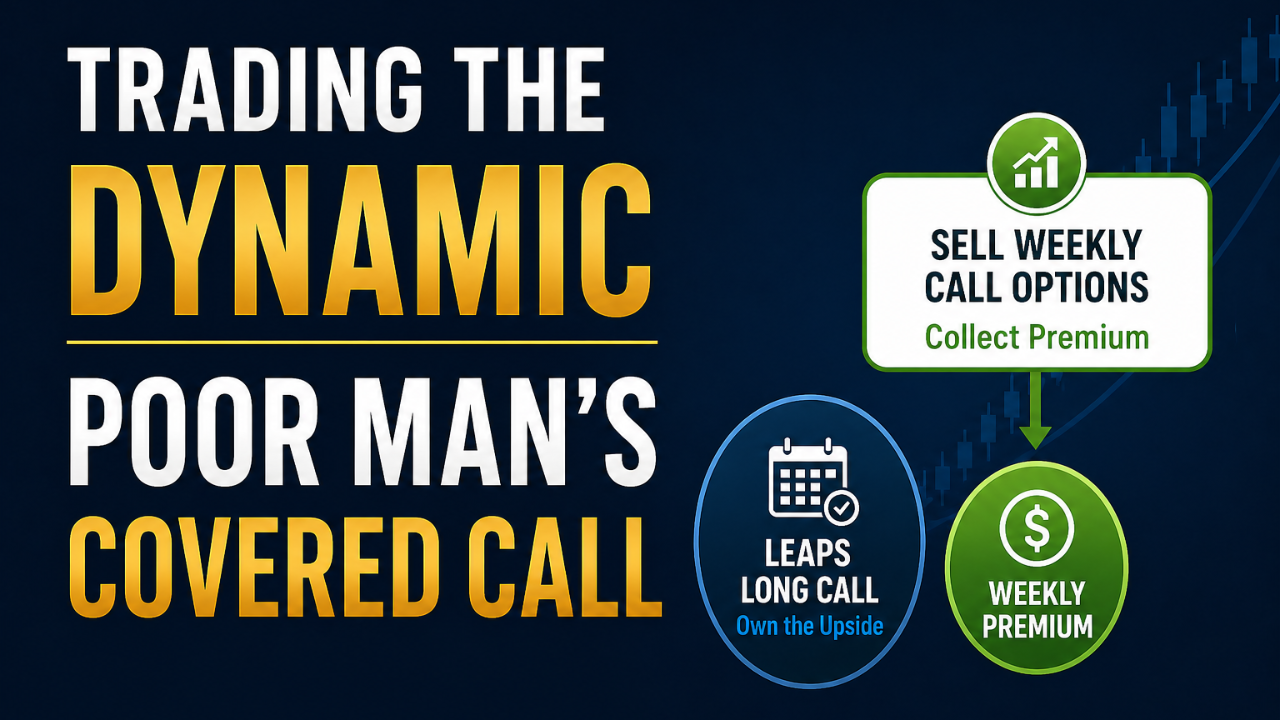
In the Dynamic Poor Man's Covered Call, we use delta deliberately.
The long LEAP leg is built at 0.70–0.80 delta. Why? Because at that level, the LEAP moves almost like the stock itself.
A 0.75 delta LEAP captures roughly 75 cents of every dollar the stock gains. It behaves like owning 75 shares for every contract, but at a fraction of the capital cost of actually owning the stock.
That's the "poor man" part. You get stock-like delta exposure without tying up full stock capital.
The short call we sell against it? We target 0.30–0.40 delta.
That strike is far enough out of the money to have high probability of expiring worthless, generating income.
But it also has meaningful premium — more than a 0.15 delta call that you'd have to sell at a strike so far away it barely pays anything.
The delta spread between the long LEAP and the short call is the net delta of the entire position. That's what drives the position's behavior. Understanding those numbers isn't optional — it's the architecture of the trade.
The Mistake: Picking Strikes Without Thinking About Exposure
Here's the mistake I see constantly, even from traders with some experience.
They screen for "0.30 delta" calls to sell. They find five different names. They sell them all. And they never stop to add up what all those short calls mean in terms of total position exposure.
Or they buy ten contracts on a position instead of three because the premium looks attractive — without realizing they've just taken on 1,000 deltas of exposure where they should have taken on 300.
Delta isn't just for picking strikes. It's for sizing positions and understanding what you own at the portfolio level.
Run through your positions right now. Multiply contracts by 100, multiply by the delta of each leg, add it all up.
That number — your portfolio delta — is your real market exposure. Not the number of positions. Not the notional value. The delta.
If that number surprises you, your position sizing needs work before your strike selection.
Quick Practical Checklist
Before entering any new options position, ask:
1. What is the delta of each leg?
2. What is my position delta (contracts × 100 × delta per leg)?
3. What does my portfolio delta become after adding this position?
4. How does that exposure change if the stock moves 5–10% against me?
That last question is where most traders stop too early. They know their entry delta. They don't model the delta drift if the trade goes wrong.
Understanding Delta Is Where the DPMCC Starts
Delta is foundational to everything we do in the DPMCC. We don't pick strikes randomly or based on yield alone.
We engineer specific delta exposure — long delta from the LEAP, short delta from the call, net delta that keeps us participating in the stock's upside while collecting consistent premium.
That engineering only works if you understand what delta is doing, how it changes, and what it means for your total portfolio exposure.
If you want to see how all of this comes together in a structured, income-generating strategy, the DPMCC Course walks through the complete framework — from delta selection at entry to adjustment rules when delta drifts.
👉 Explore the DPMCC Course here
Stay connected with news and updates!
Join our mailing list to receive the latest news and updates from our team.
Don't worry, your information will not be shared.
We hate SPAM. We will never sell your information, for any reason.
