
A Good Trade Can Still Lose Money
Jul 02, 2026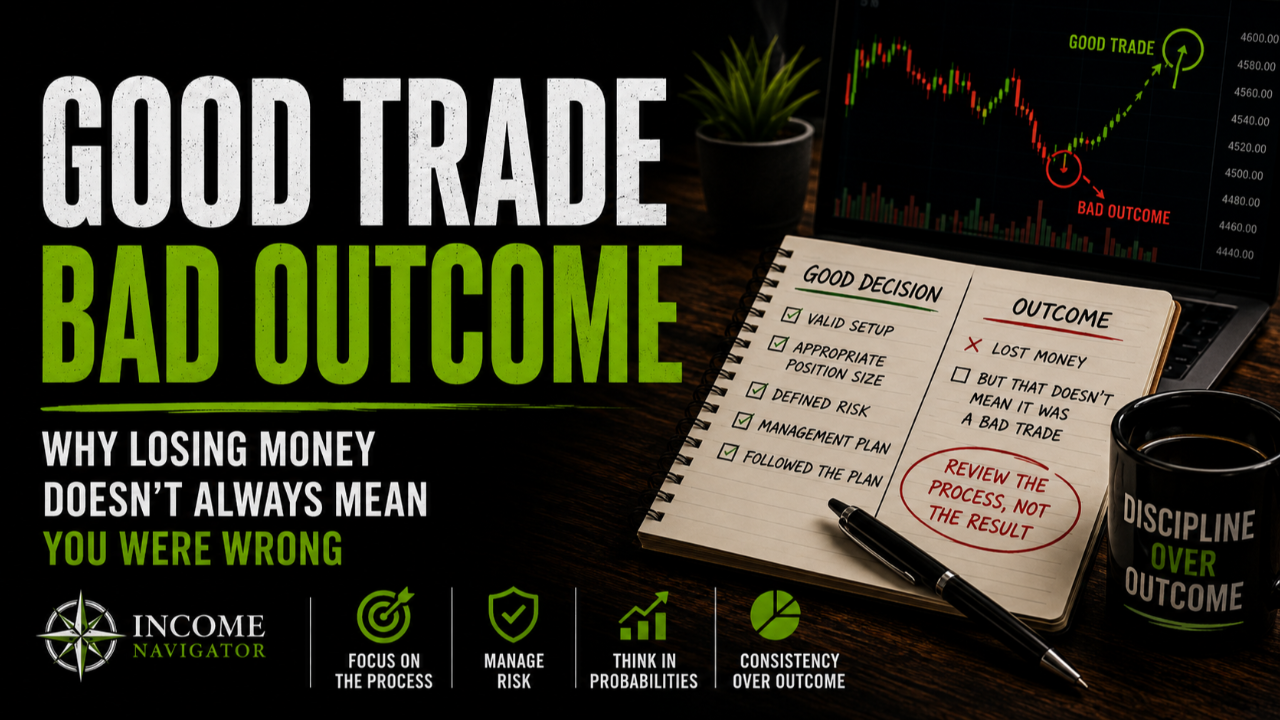
One of the hardest things to accept in trading is that you can do everything right and still lose money.
You can have a good setup.
You can size the position correctly.
You can understand the risk.
You can follow your management plan exactly as intended.
And the trade can still lose.
That does not automatically mean you made a bad trade.
This is one of the most important concepts in trading psychology because traders have a natural tendency to judge the quality of a decision based entirely on the outcome.
Green P&L means good trade.
Red P&L means bad trade.
Trading does not work that way.
Trading Is a Game of Probabilities
There are no guarantees in trading.
You can find a high-probability setup and still end up on the losing side of the distribution.
If a trade has a 70% probability of success, that still means there is a 30% probability it does not work.
That losing outcome does not suddenly make the original decision wrong.
It simply means one of the losing outcomes occurred.
This distinction matters.
Because if you expect every good trading decision to immediately produce a profitable result, you're eventually going to start changing good decisions based on short-term outcomes.
A Simple Example
Imagine I offered you the following game.
Every time we flip a fair coin:
- If it lands on heads, you make $2.
- If it lands on tails, you lose $1.
Would you play?
You should.
Over a large enough number of flips, you have a positive expected value.
But here's the important part.
You can still lose the first flip.
You could lose the first three flips.
You might even experience a longer losing streak at some point.
None of those individual outcomes change the mathematics of the game.
The edge only becomes visible over enough repetitions.
Trading works in much the same way.
You are not trying to guarantee the outcome of one trade.
You are trying to repeatedly make decisions where the probability, potential reward, and risk make sense.
Outcome Bias Is Dangerous
Traders naturally want to work backward from the result.
A trade makes money and they say:
"That was a great trade."
A trade loses money and they immediately ask:
"What did I do wrong?"
Sometimes the answer is absolutely something.
Maybe the position was too large.
Maybe the entry was poor.
Maybe you ignored your risk management rules.
Maybe you never fully understood the risk in the first place.
Those situations should be reviewed.
But sometimes the answer is:
Nothing.
You followed the process and experienced a losing outcome.
That's part of trading.
This works in both directions. A losing trade can come from a good decision, just as a profitable trade can come from a bad one. I covered the other side of this in A Bad Trade Can Make Money — And That's More Dangerous.
The Better Question to Ask After a Losing Trade
Instead of asking whether a trade made or lost money, ask yourself a different question:
If I could go back to the moment before I entered this trade, knowing only what I knew at the time, would I take it again?
That's a much harder question.
But it's also much more useful.
It forces you to evaluate the decision based on the information available when the decision was actually made.
Ask yourself:
- Did the setup meet my criteria?
- Was the position sized appropriately?
- Did the risk make sense within my portfolio?
- Did the potential return justify that risk?
- Did I know what would cause me to exit or adjust?
- Did I actually follow my management plan?
If the answer to those questions is yes, the fact that the trade lost does not necessarily invalidate the decision.
A Good Trading Process Will Still Produce Losing Trades
This is something every trader needs to internalize.
A profitable trading process must include losing trades.
If your strategy wins 70% of the time, approximately 30% of the trades will still be losers over a sufficiently large sample.
Those losses aren't necessarily evidence that the strategy stopped working.
They're part of the expected distribution of outcomes.
The real danger begins when traders constantly change their strategy because of a few recent losses.
They take a loss and immediately adjust something.
Another loss happens and they change something else.
Then another.
Before long, they're no longer following a strategy.
They're reacting emotionally to whatever happened most recently.
This Is Why Sample Size Matters
One or two trades tell you almost nothing about whether a trading process has an edge.
Even ten trades may not tell you very much.
You need enough observations to begin separating normal variance from a genuine problem with the strategy.
That doesn't mean blindly following something that clearly isn't working.
It means understanding that short-term results can be noisy.
A strategy can experience several losses in a row and still have positive long-term expectancy.
This is also why position sizing matters so much.
If every losing trade feels catastrophic, you're probably not going to give your edge enough opportunities to play out.
Instead, you'll be tempted to interfere with trades, abandon strategies after normal losing streaks, or make emotional decisions because the dollar amounts have become too uncomfortable.
Good Trading Is About Decision Quality
The goal isn't to eliminate losing trades.
You can't.
The goal is to consistently make good decisions under uncertainty.
That means focusing on the things you can actually control:
- Your position size
- Your entry criteria
- Your risk
- Your trade structure
- Your management plan
- Your discipline
You cannot control what the market does after you enter.
That's the part traders often struggle with the most.
We want the market to validate our decision immediately.
But the market doesn't owe us that validation.
Don't Let One Loss Rewrite Your Process
A losing trade deserves a review.
But that review should be objective.
Ask whether something in the process was wrong.
Don't assume something was wrong simply because the trade lost money.
There is a big difference between:
"This trade lost."
and
"This was a bad trade."
Those are not the same statement.
The first describes the outcome.
The second describes the quality of the decision.
Learning to separate the two is one of the biggest steps you can take toward becoming a more disciplined trader.
Focus on the Process
Your job as a trader isn't to predict every market move correctly.
Your job is to build a process that can survive being wrong.
Take good setups.
Size them appropriately.
Understand the risk.
Follow your management rules.
Then give the probabilities enough opportunities to play out.
A good trade can lose money.
And as we discussed in A Bad Trade Can Make Money, a bad decision can sometimes produce a profitable outcome.
That's exactly why the P&L from one trade should never be the only way you judge your performance.
Judge the process.
Because over enough trades, the quality of that process is what matters.
Build a Better Trading Process
Finding trades is only one part of becoming a successful trader.
Understanding probability, position sizing, risk management, and how individual positions fit together inside a portfolio is just as important.
That's what we focus on inside Income Navigator.
Our goal isn't simply to give traders another strategy to follow. It's to help them understand why they're making a trade, what they're risking, and how to manage that risk when the market doesn't cooperate.
Stay connected with news and updates!
Join our mailing list to receive the latest news and updates from our team.
Don't worry, your information will not be shared.
We hate SPAM. We will never sell your information, for any reason.
