
How to Choose a LEAP for a DPMCC
Sep 29, 2026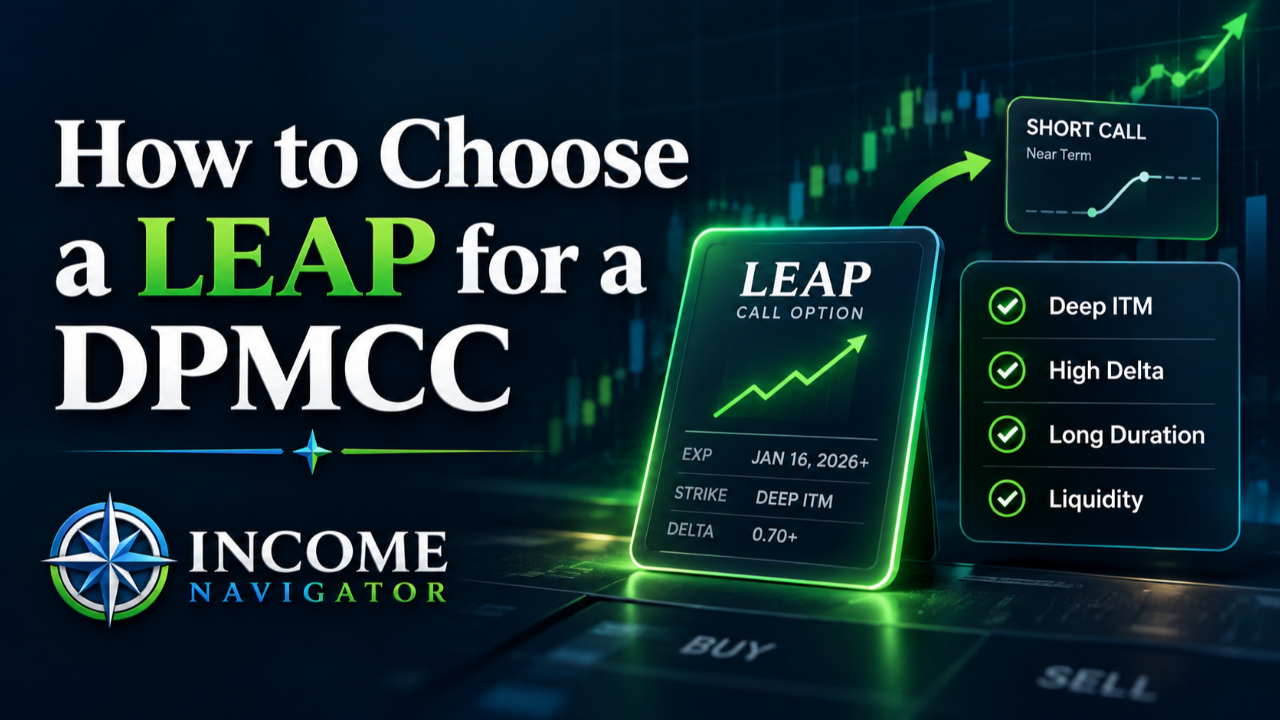
The long LEAP is the foundation of a Dynamic Poor Man’s Covered Call.
It is the part of the position that creates the long exposure.
It is the part that can lose the most value when the underlying falls.
And it is the part that determines whether the short-call income process has a strong foundation or a weak one.
That is why choosing a LEAP should not begin with one question.
“Which call is the cheapest?”
A cheap call may be far out of the money.
It may have low delta.
It may not behave enough like stock for the role it is supposed to play.
And it may leave the entire DPMCC campaign dependent on a large move just to work.
The underlying matters.
The strike matters.
The expiration matters.
Delta matters.
Intrinsic and extrinsic value matter.
And the full dollar amount at risk matters more than any single number on the option chain.
Start With the Underlying, Not the Option Chain
The stock or ETF comes before the LEAP.
That is the first decision.
A DPMCC uses a long-dated call as a stock replacement.
So before looking at strikes, expirations, or premiums, ask whether you actually want long exposure to the underlying.
Would you be comfortable owning the stock if it declines?
Do you understand the business, the sector, and the risks that may affect it?
Does the underlying fit your broader portfolio?
And does it have a liquid options chain that can support both the long LEAP and ongoing short-call management?
Do not start with:
“Which stock has the highest option premium?”
High premium can reflect uncertainty.
It can reflect earnings risk.
It can reflect expected movement, poor liquidity, or a market that expects a difficult event.
The first question is simpler.
“Would I want to keep long exposure to this underlying if the trade becomes uncomfortable?”
If the answer is no, the DPMCC may not be the right structure.
📖 Related Reading
The long LEAP is one piece of a larger DPMCC campaign.
Before selecting the long call, understand how the long LEAP and short call work together, why the strategy is dynamic, and where the real risk sits across the full position.
Read Dynamic Poor Man’s Covered Call: Complete DPMCC Strategy Guide →
What the Long LEAP Is Supposed to Do
The long LEAP is intended to provide long directional exposure.
In a DPMCC, it takes the place of owning 100 shares of stock.
It does not need to move exactly like 100 shares.
But it should provide enough meaningful exposure for the strategy to function as intended.
That is why many traders look at deep-in-the-money calls.
A deep-in-the-money call generally has more intrinsic value and a higher delta than a call that is at the money or out of the money.
Higher delta means the call may respond more to changes in the underlying price.
For example, a 0.80 delta call may move by approximately $0.80 for a $1 move in the stock, all else equal.
That does not mean it will move exactly $0.80 every time.
Delta changes as the stock moves, time passes, and implied volatility changes.
But it helps explain why a higher-delta LEAP may behave more like the long exposure a DPMCC is designed to create.
A low-delta call may cost less.
But it may behave more like a speculative bet on a large upside move than a stock replacement.
That is a different trade.
Use Delta as a Starting Point
Delta is one of the most useful tools for comparing long-call choices.
But it is not a magic number.
And it is not a guarantee of future performance.
For a DPMCC, many traders begin by evaluating deeper-in-the-money long calls with relatively higher delta.
A long call with a delta near 0.70, 0.75, 0.80, or higher may provide more stock-like exposure than a call near 0.50 delta.
But a higher-delta call also usually costs more.
That is the tradeoff.
You are paying for more intrinsic value and more immediate directional exposure.
A lower-delta call may require less capital.
But it may require a larger stock move to respond the way you expect.
It may also lose delta quickly if the underlying falls.
The goal is not to blindly choose the highest possible delta.
The goal is to understand how much exposure the long call provides, how much capital it requires, and whether that combination fits the role of the LEAP in the campaign.
Example: Comparing two long calls
- Underlying stock price: $100
- Long Call A: $70 strike, longer-dated expiration, approximately 0.80 delta
- Long Call B: $100 strike, same expiration, approximately 0.50 delta
The deeper-in-the-money $70 call may cost more because it contains more intrinsic value. But it may respond more like stock and may be better suited to serve as the long foundation of a DPMCC.
The at-the-money $100 call may cost less. But it can contain more extrinsic value, have lower starting delta, and require more upside movement before it behaves like the intended stock replacement. Neither call is automatically right. The decision depends on the objective, total risk, and position size.
📖 Related Reading
Delta helps describe exposure. It does not promise an outcome.
Learn what delta actually measures, why it changes, and why a delta target should never replace a complete view of the underlying, position size, and risk.
Choose a Strike With the Stock-Exposure Goal in Mind
The strike price determines how much of the option’s value is intrinsic and how much is extrinsic.
For a call option, intrinsic value is the amount by which the stock price is above the strike price.
If a stock is trading at $100 and you buy an $80 call, that call has $20 of intrinsic value.
Any price above that intrinsic value is extrinsic value.
Extrinsic value reflects time, volatility, and uncertainty.
A deeper-in-the-money long call usually contains more intrinsic value and less of its total price in extrinsic value than a nearer-the-money call.
That can make it more suitable for a DPMCC stock-replacement role.
But deeper-in-the-money does not mean automatically better.
The option still has a price.
It still has a finite expiration date.
And the total debit still has to fit the portfolio.
Choosing a strike is not about finding the greatest leverage.
It is about finding a long option that gives the campaign enough directional exposure without committing an amount of capital that becomes too large for the account.
Ask yourself:
- How much of this option’s value is intrinsic?
- How much is extrinsic?
- How closely does the delta fit the stock-replacement objective?
- What is the full debit in dollars?
- Would this debit still be manageable after a meaningful pullback in the underlying?
A lower strike can increase stock-like behavior.
But it can also increase the capital required.
The best strike is not the lowest strike or the cheapest strike.
It is the strike that fits the overall risk plan.
Give the Trade Enough Time
A DPMCC uses a long-dated call because time matters.
The long LEAP needs enough time to serve as the foundation for repeated short-call decisions.
A longer expiration can give the trader more room to manage ordinary movement in the underlying.
It can also give the long call more time to retain its stock-replacement role.
But longer time does not mean no time decay.
Every long option has an expiration date.
And the amount of extrinsic value can decline as that date approaches.
For that reason, traders often prefer to start with meaningful time remaining rather than building a DPMCC on a long call that is already close to expiration.
The exact number of days or months will depend on the underlying, the option chain, the capital required, and the trader’s management plan.
There is no single expiration that is correct for every account.
What matters is that the long call provides enough runway for the intended campaign and enough time to make management decisions before expiration becomes urgent.
The key point is simple.
Do not wait until the final days of the long option to decide what it means for the position.
Expiration planning should begin at entry.
📖 Related Reading
A LEAP has more time. It does not have unlimited time.
Long-dated options can provide more flexibility than short-term contracts, but expiration, time value, and long-call management remain part of the decision from the beginning.
Read Beginner’s Guide to Trading LEAPs: How to Profit with Long-Term Options →
Check Liquidity Before Entering
A DPMCC is not a one-time trade.
The long LEAP may need to be rolled or closed later.
The short call may need to be sold, bought back, rolled, or adjusted over multiple cycles.
That makes liquidity important.
Liquidity affects the price you can enter.
It affects the cost of closing or rolling.
And it affects whether a trade that looks attractive in theory can actually be managed efficiently in real markets.
Before entering a DPMCC, review:
- The bid-ask spread on the long LEAP
- The bid-ask spread on the shorter-term calls you may sell
- Open interest and volume across the strikes you are considering
- Whether the underlying itself trades actively
- Whether you can realistically enter and exit without giving up too much value to wide spreads
A low-priced option with a wide bid-ask spread may not be a bargain.
An illiquid LEAP can become difficult to manage when the position needs attention.
And an illiquid short-call chain can make every future premium sale and roll less efficient.
Liquidity is not a cosmetic detail.
It is part of the strategy’s risk.
Calculate the Actual Dollar Risk
The cost of the LEAP is not just an option price.
It is a dollar amount at risk.
If a LEAP costs $30.00, one contract costs $3,000 before commissions and fees.
That $3,000 may be less than the cost of buying 100 shares of a $100 stock.
But it is still real capital.
And the long call can lose a substantial amount of value if the underlying falls.
That is why the trade should be sized based on the full debit and the exposure it creates.
Do not size the position based only on the premium you expect to collect from the short call.
A $150 short-call credit does not make a $3,000 long-call risk small.
Before entering, consider:
- The full debit paid for the long LEAP
- The amount you can realistically lose if the stock declines substantially
- The delta exposure created by the long call
- The number of DPMCC positions already open
- Your exposure to the same stock, sector, or market theme
- Whether a broad market pullback would pressure several positions at once
A DPMCC can be capital efficient.
But capital efficiency is not the same thing as low risk.
It simply changes how the exposure is created.
📖 Related Reading
Position size determines whether normal movement becomes an emotional problem.
A trade can be technically defined risk and still be too large. Learn why position size affects decisions, discipline, and the ability to stay with a plan during volatility.
Read Position Sizing: How Trade Size Changes Your Psychology →
Consider Volatility and Event Risk
Implied volatility affects option prices.
That includes the price of the long LEAP.
And it includes the premium available from the shorter-term calls you may sell later.
High implied volatility can make short-call premium look attractive.
But it can also make the long LEAP more expensive and reflect real uncertainty in the underlying.
Before selecting a LEAP, consider whether earnings, company news, dividends, economic events, or broader market uncertainty may affect the position.
There is no requirement to avoid every event.
But there should be a reasoned decision.
Do not treat high option premium as automatic income.
And do not assume a long-dated expiration makes event risk irrelevant.
A sharp move in the underlying can still change the entire campaign quickly.
📖 Related Reading
Higher premium can be compensation for a risk you have not fully priced in.
Before entering an options position because premium or volatility looks attractive, understand whether the market is pricing earnings risk, gap risk, liquidity risk, or another form of uncertainty.
Read High IV Options: Why Higher Premium Means Higher Risk →
Avoid Choosing a LEAP Only Because It Is Cheap
The cheapest call is often not the best stock replacement.
A low-cost call may be far out of the money.
It may have low delta.
It may contain mostly extrinsic value.
And it may require a large move in the stock before it provides meaningful directional exposure.
That may be appropriate for a speculative directional trade.
But it may not be appropriate for the long foundation of a DPMCC.
The DPMCC needs a long call that can support the short-call process.
If the long option has too little delta, too little intrinsic value, or too little time, the position can become more fragile.
A lower-cost LEAP is not automatically a lower-risk LEAP.
And a higher-cost LEAP is not automatically better.
The goal is balance.
Choose the long call that gives the campaign appropriate exposure, sufficient time, workable liquidity, and a debit that fits the portfolio.
Plan for the LEAP Before You Enter
The long LEAP will not remain a long LEAP forever.
Every day, the expiration date gets closer.
The underlying may rise.
It may decline.
And the option’s delta, intrinsic value, extrinsic value, and risk profile can all change.
That means a long-LEAP plan should exist before the position is opened.
Ask:
- How much time remains at entry?
- When will I reassess the long call?
- What conditions would cause me to close the campaign?
- What conditions would cause me to roll or replace the long LEAP?
- How will I handle the position if the stock declines materially?
- How will I handle the position if the stock rallies and the short call becomes a problem?
- What will I do if the long option approaches expiration?
The DPMCC is not one trade.
It is a campaign.
The LEAP selection is the first decision.
But it is not the last one.
📘 Continue Learning
Choosing the LEAP is the first decision. Managing the campaign is the ongoing process.
The Dynamic Poor Man’s Covered Call course walks through long-LEAP selection, short-call decisions, weekly management, rolling, pullbacks, rallies, position size, and the broader process behind a complete DPMCC campaign.
LEAP Selection Checklist for a DPMCC
Before buying a long LEAP for a DPMCC, ask:
- Do I want long exposure to this underlying beyond the next short-call cycle?
- Is the stock or ETF liquid, and does it have a liquid options chain?
- Does the long call have enough time remaining for the intended campaign?
- How much intrinsic value does the option have?
- How much extrinsic value am I paying?
- What is the delta of the long call, and does it fit the stock-replacement objective?
- What is the full debit cost in actual dollars?
- Can my portfolio absorb a meaningful loss in the long call?
- What is the bid-ask spread, and can the position be managed efficiently later?
- Are earnings, dividends, or other events likely to change the risk?
- How does this position fit with my other stock, sector, and market exposure?
- What is my plan for managing or replacing the long LEAP before expiration?
If the answers are unclear, the long call may not be ready to support a DPMCC campaign.
The Bottom Line
The long LEAP is the foundation of a Dynamic Poor Man’s Covered Call.
It creates the long directional exposure.
It carries much of the capital at risk.
And it determines whether the short-call income process has a stable base or a fragile one.
Choose the underlying before the option chain.
Use delta to understand exposure, not as a guarantee.
Look at intrinsic and extrinsic value.
Give the trade enough time.
Check liquidity.
Calculate the full dollar risk.
And build a plan for the long LEAP before the position is opened.
It is the position that carries the exposure, the time risk, and much of the responsibility for the entire campaign.
Learn the DPMCC Process Step by Step
Choosing a long-dated call is only the beginning.
The real work begins after the DPMCC is open.
How do you decide when to sell a short call?
How much upside should you leave open?
What happens when the stock rallies and the short call moves in the money?
What happens when the stock pulls back and the long LEAP loses value?
When should you roll?
When should you close a campaign instead of trying to repair it?
And how do you keep several positions from creating more portfolio exposure than you intended?
The Dynamic Poor Man’s Covered Call course was created for traders who want a structured framework for making those decisions.
Inside the course, you will learn how to:
- Choose and structure the long LEAP as a stock replacement
- Evaluate intrinsic and extrinsic value within the campaign
- Select short calls based on the market environment and trade objective
- Use a repeatable weekly process for monitoring and managing positions
- Handle rallies, pullbacks, in-the-money short calls, earnings, and dividend risk
- Decide when a roll makes sense and when a position should be closed instead
- Maintain long LEAPs as time passes and expiration gets closer
- Apply position-size and portfolio-allocation rules across multiple campaigns
- Use a trade tracker and weekly execution checklist to reduce emotional decisions
The course is not built around finding a perfect trade.
It is built around knowing what to do before entry, while the position is open, and when it is time to adjust, exit, or recycle capital.
If you want to learn the complete Dynamic Poor Man’s Covered Call process, explore the DPMCC course here.
A step-by-step framework for structuring, managing, and adjusting a Dynamic Poor Man’s Covered Call campaign.
Options trading involves substantial risk of loss and is not appropriate for all investors. Past performance is not indicative of future results. This content is for educational purposes only and should not be considered investment, legal, or tax advice.
Stay connected with news and updates!
Join our mailing list to receive the latest news and updates from our team.
Don't worry, your information will not be shared.
We hate SPAM. We will never sell your information, for any reason.
