
Your Position Size Changes Your Psychology
Jul 04, 2026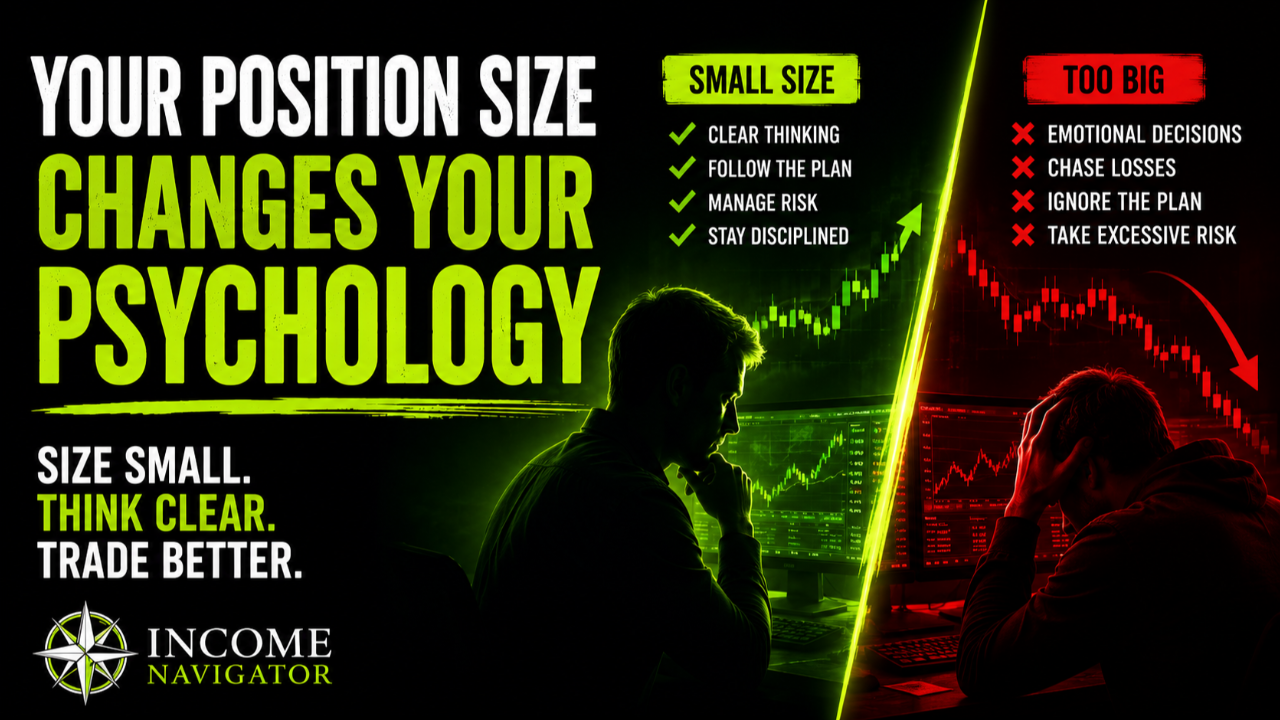
Two traders can put on the exact same trade and have completely different experiences.
Same underlying.
Same strikes.
Same expiration.
Same entry price.
But one trader calmly follows the plan while the other watches every tick, checks futures overnight, and starts making adjustments the moment the position moves against them.
What's the difference?
Very often, it's not the trade.
It's the position size.
We usually talk about position sizing as a risk management tool.
And it absolutely is.
But position size does something else that doesn't get discussed nearly enough.
It changes the way you think.
The Same Trade Feels Different at 1 Contract and 10 Contracts
Imagine you put on an options trade and decide that you're willing to risk $500.
The position moves against you by $200.
That's uncomfortable, but manageable.
You understand that trades fluctuate. Nothing about your original thesis has changed, and you're still well within the risk you accepted before entering.
Now imagine the exact same market move with a position ten times larger.
Instead of being down $200, you're down $2,000.
The chart hasn't changed.
The probabilities haven't changed.
The underlying hasn't changed.
But you have.
Suddenly, every tick matters.
You start looking for reasons to adjust.
You check the position constantly.
You start questioning a trade you were perfectly comfortable with a few hours earlier.
That's why position sizing isn't just about how much money you can lose.
It's also about whether you can continue making rational decisions while the trade is working.
Trading Too Large Changes Your Behavior
Most traders assume that they'll behave the same way regardless of position size.
They won't.
Increase the dollar amounts enough and your decision-making starts to change.
You may:
- Take profits too early because you're afraid to give money back.
- Exit good positions during normal fluctuations.
- Ignore stops because the loss feels too painful to realize.
- Make unnecessary adjustments just to feel like you're doing something.
- Watch every market tick instead of following your original plan.
- Lose sleep worrying about what the market will do tomorrow.
And here's the interesting part.
A trader experiencing those problems often concludes:
"I need more discipline."
Maybe.
But sometimes the solution is much simpler.
You need less size.
If You Can't Follow the Plan, the Position May Be Too Large
Before entering a trade, everything tends to look easy.
You calculate your risk.
You establish your stop.
You decide when you'll adjust.
You know exactly what you're going to do.
Then real money starts moving.
That's when you find out whether the position was actually sized appropriately.
A position isn't properly sized simply because your account has enough buying power to hold it.
Buying power tells you whether you can open the trade. It doesn't tell you whether you should.
The better question is whether the position allows you to execute your plan when the market moves against you.
If a normal drawdown causes you to abandon your strategy, the position may simply be too large.
The Stop You Couldn't Take
This becomes especially obvious when it's time to take a loss.
Suppose your trading plan says you'll exit a position at a $500 loss.
The trade reaches that level.
But you can't bring yourself to close it.
You tell yourself:
"I'll give it a little more room."
The loss grows to $750.
Now taking the loss is even harder.
So you wait.
At $1,000, you're no longer thinking about whether the trade makes sense.
You're thinking about getting back to $500 so you can finally get out.
At $1,500, maybe you're just hoping to get back to breakeven.
The original trading plan disappeared a long time ago.
That's how a manageable trading loss can become a portfolio problem.
And often the real mistake wasn't made when the stop was ignored.
The mistake was made when the position was opened too large.
This is closely related to something I discussed in A Bad Trade Can Make Money — And That's More Dangerous. Sometimes ignoring the stop works. The position recovers, and the trader gets rewarded for taking too much risk.
That's exactly how bad habits get reinforced.
Position Size Determines Whether Your Strategy Gets a Chance to Work
There is another reason proper position sizing matters.
Every trading strategy experiences losing trades.
Every strategy experiences drawdowns.
And every strategy will eventually experience a sequence of losses that feels worse than usual.
If your positions are too large, you may never survive that normal variance long enough for the strategy's edge to play out.
Let's say you have a strategy with positive expectancy.
It works over hundreds of trades.
But you size each position so aggressively that three consecutive losses create a major drawdown in your account.
The strategy may be perfectly fine.
Your position sizing isn't.
As I explained in A Good Trade Can Still Lose Money, losing trades are part of any probability-based trading process.
Your position size has to allow you to survive them.
Account Size Is Only Part of the Equation
Traders often think about position sizing entirely as a percentage of account value.
That's a good starting point.
But it's not the entire equation.
You also need to consider:
- The maximum realistic loss on the position.
- The notional exposure you're adding to the portfolio.
- How correlated the position is with your other trades.
- How much buying power the trade could require if volatility increases.
- How the position behaves during a large move in the underlying.
- Whether several positions could move against you simultaneously.
This becomes particularly important when trading options.
The buying power requirement you see when entering a trade is not necessarily the buying power requirement you'll have during a major market move.
Volatility can expand.
Greeks can change.
Correlations can increase.
Positions that looked unrelated can suddenly start moving together.
That's why I prefer thinking about risk at the portfolio level, not just one trade at a time.
Your Portfolio Doesn't Care How Many Trades You Have
Imagine you have five different bullish positions.
They may use different strategies.
They may have different expiration dates.
They may even be in different underlyings.
But if they're all ultimately exposed to the same market move, you may not really have five independent trades.
You may have one large directional bet divided across five positions.
That's why simply saying:
"I only risk 2% on each trade."
doesn't necessarily tell you how much portfolio risk you're actually carrying.
Position sizing needs context.
What happens to the entire portfolio if the market moves against you?
That's the question that matters.
The Right Size Is the Size You Can Manage
There's no universal number of contracts that makes a trade appropriately sized.
Ten contracts may be insignificant for one portfolio and reckless for another.
Instead, think about position size in terms of consequences.
If this trade experiences its expected adverse move:
- Can I comfortably take the planned loss?
- Will I still follow my management rules?
- Will I be tempted to interfere with the trade?
- Will the loss materially change my portfolio?
- Can I withstand several similar losses in a row?
If the answers make you uncomfortable, reducing the size may improve more than your risk.
It may improve your decision-making too.
Smaller Size Can Make You a Better Trader
Traders often assume that making more money requires trading bigger.
Sometimes the opposite is true.
Smaller positions can give you the freedom to let trades work.
They can make it easier to take losses when you're supposed to.
They can prevent normal market fluctuations from turning into emotional events.
And they can give your trading process enough repetitions for the probabilities to actually matter.
Your position size doesn't just determine how much money you can make or lose.
It determines what kind of trader you become once the money starts moving.
If you're constantly anxious, adjusting positions unnecessarily, ignoring stops, or watching every tick, don't immediately assume you have a discipline problem.
Look at your size.
Because sometimes the easiest way to improve your trading psychology isn't learning how to tolerate more risk.
It's taking less of it.
Build Risk Around the Portfolio, Not Just the Trade
At Income Navigator, we don't look at trades in isolation.
We focus on understanding position sizing, probability, options risk, portfolio exposure, and how multiple positions work together.
Because finding a good trade is only the beginning.
The bigger challenge is making sure you're still around to take the next one.
Stay connected with news and updates!
Join our mailing list to receive the latest news and updates from our team.
Don't worry, your information will not be shared.
We hate SPAM. We will never sell your information, for any reason.
