
The Trade You Couldn't Take a Stop On Was Probably Too Big
Jul 08, 2026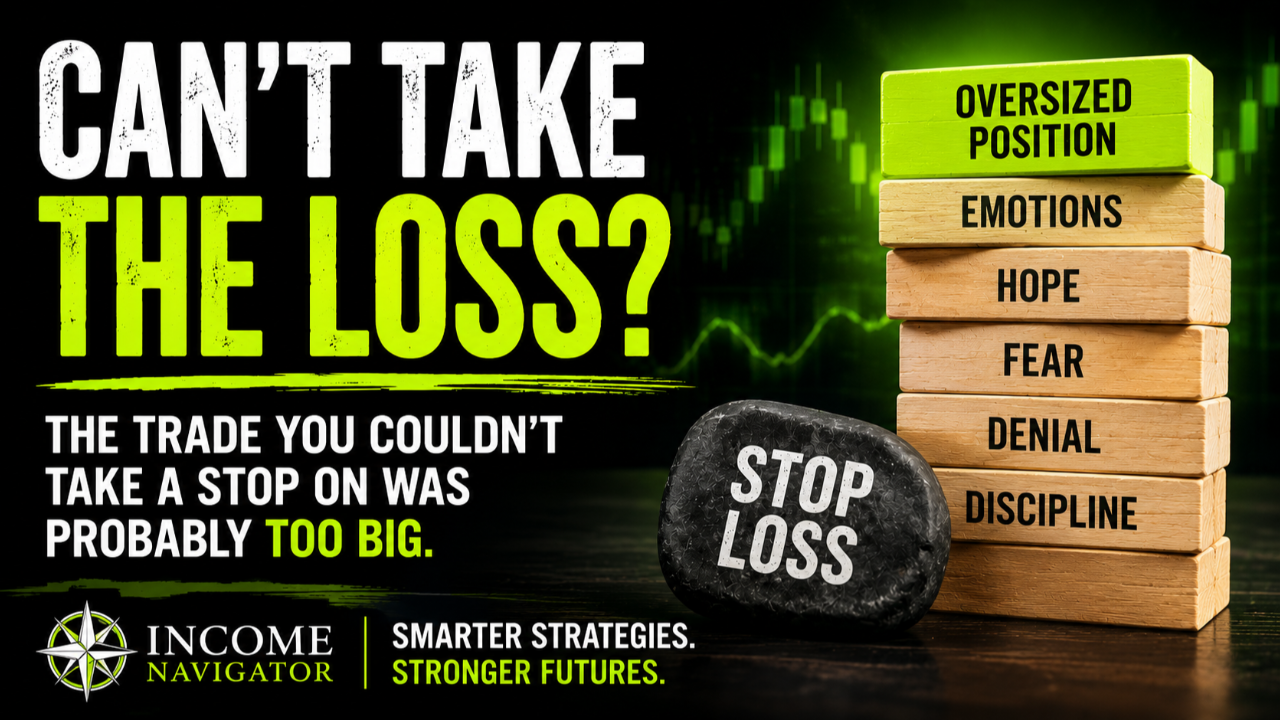
You've probably seen this happen.
A trader enters a position with a clear risk management plan.
If the trade loses $500, they're getting out.
Simple.
Then the trade reaches a $500 loss.
And suddenly the plan changes.
"I'll give it a little more room."
At $750:
"It's already down this much. I might as well wait for a bounce."
At $1,000:
"I'll get out when it comes back to $500."
At $1,500, the trader isn't managing the position anymore.
They're hoping the market rescues them.
Most people look at this situation and say the trader lacks discipline.
Maybe.
But I think the real mistake often happened much earlier.
The position was too big when the trade was opened.
A Stop Loss Only Works If You Can Actually Take It
It's easy to establish a stop before entering a trade.
There's no P&L moving yet.
No emotion.
No pain associated with clicking the close button.
Then real money starts disappearing.
That's when you discover whether your position sizing actually matches your risk tolerance.
If you decide before entering that you're willing to lose $500 but can't bring yourself to take the loss when it happens, then $500 probably wasn't your true risk tolerance.
It was just a number you were comfortable with when it wasn't real yet.
The Larger the Loss Gets, the Harder It Becomes to Exit
Here's the cruel part.
Once you ignore the original stop, taking the loss usually becomes harder, not easier.
A $500 loss becomes $750.
Now you wish you had exited at $500.
At $1,000, suddenly $500 sounds fantastic.
So instead of asking whether you still want the position, you start negotiating with the market.
"Just get me back to $500 and I'll close it."
The market doesn't know where you entered.
It doesn't know your P&L.
And it certainly doesn't care where you want to get out.
Your original trading decision has now been replaced by an emotional attachment to a number on your screen.
Sometimes the Market Rewards You for Ignoring the Stop
Unfortunately, sometimes this works.
The $1,000 loss turns around.
The position comes all the way back.
You close it for a $200 profit.
And instead of learning that you took too much risk, you learn something much more dangerous:
"See? I was right not to take the stop."
I wrote about this exact problem in A Bad Trade Can Make Money — And That's More Dangerous.
The market occasionally rewards terrible risk management.
That doesn't make the decision correct.
The Problem Isn't Always the Stop
When traders repeatedly ignore their stops, they often start experimenting with different stop-loss rules.
Maybe 2x the credit is too tight.
Maybe 3x is better.
Maybe they shouldn't use stops at all.
Sometimes those are legitimate strategy questions.
But before changing the stop, ask something simpler:
Would I have followed the exact same rule if this position were half the size?
If the answer is yes, you probably don't have a stop-loss problem.
You have a position-sizing problem.
Buying Power Doesn't Tell You How Much You Should Trade
This becomes especially dangerous with options.
A broker might require only a fraction of the true economic exposure to open a position.
That can create the illusion that the trade is smaller than it really is.
If a position uses $10,000 of buying power, that doesn't necessarily mean your risk is $10,000.
And it definitely doesn't mean putting on five of them is appropriate simply because your account has $50,000 of buying power available.
This is why understanding notional leverage and risk in options trading matters so much.
Your broker determines what you're allowed to trade. You determine what you can afford to lose.
Size the Position Around the Bad Outcome
Most traders size positions while thinking about how much money they can make.
Try doing the opposite.
Before entering, imagine the trade reaches your predetermined loss.
Now ask:
- Can I close this position without hesitation?
- Will this loss materially affect my account?
- Will I feel the need to change my rules?
- Can I take several losses like this without damaging the portfolio?
- Will I still be able to take the next good trade?
If the answer to those questions is no, reduce the position size before entering.
This is exactly why a trading strategy needs to exist inside a larger system. Entry rules alone aren't enough. Position sizing, risk allocation, exits and adjustments all have to work together. I go deeper into that distinction in Trading Strategies vs. Trading Systems: Why Most Traders Struggle.
The Best Stop Is the One You Can Actually Execute
A risk management plan isn't useful because it looks good in a spreadsheet.
It's useful because you can follow it when real money is on the line.
If a normal losing trade causes you to abandon your rules, move your stop, stare at every tick and hope for a recovery, don't immediately assume you need more discipline.
Look at your size.
The best traders aren't comfortable taking losses because they enjoy losing money.
They're comfortable taking losses because no individual loss is large enough to threaten the portfolio or change the way they think.
Sometimes becoming more disciplined doesn't require becoming mentally tougher.
Sometimes you just need to trade smaller.
See How We Manage Risk in Real Trades
Knowing what you should do is easy.
Doing it while the market is moving and real money is on the line is where trading gets difficult.
Inside Income Navigator, we work through real options trades and focus on the entire process — entries, position sizing, adjustments, exits and portfolio risk.
It's not about blindly following alerts. The goal is to understand why we're making the trade and how we're managing it when the market doesn't cooperate.
If you'd like to trade alongside our community and see that process in real time:
Stay connected with news and updates!
Join our mailing list to receive the latest news and updates from our team.
Don't worry, your information will not be shared.
We hate SPAM. We will never sell your information, for any reason.
