
Trading Strategies vs Trading Systems: Why Most Traders Struggle
Jun 07, 2026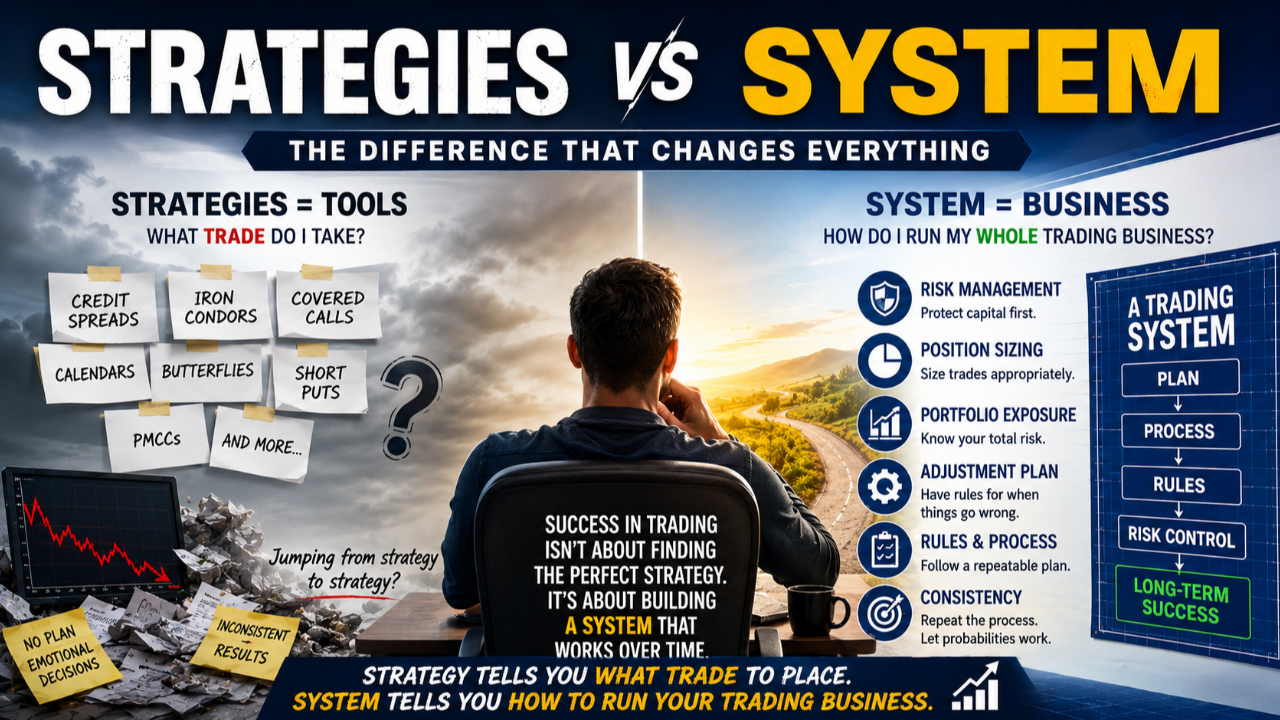
One of the biggest mistakes traders make isn't choosing the wrong strategy.
It's believing that a strategy is a trading system.
Most traders spend years jumping from one strategy to another:
- Credit spreads
- Iron condors
- Covered calls
- Calendars
- Butterflies
- Short puts
- PMCCs
They watch a YouTube video, see a few winning examples, and think they've found the answer.
Then the strategy stops working.
So they move on to the next one.
And the cycle repeats.
The problem isn't the strategy.
The problem is that they never built a system around it.
A Strategy Is Just a Tool
Think of a strategy like a hammer.
A hammer isn't a house.
It's just one tool used to build a house.
Likewise, a short put isn't a trading business.
Neither is an iron condor.
Neither is a covered call.
They're simply tools that can be used within a larger framework.
When traders focus exclusively on the strategy, they become obsessed with entries.
They spend almost all their time asking:
- What delta should I sell?
- Which expiration?
- Which strike?
- What ticker?
These questions matter.
But they're often the least important part of long-term success.
The Real Questions Successful Traders Ask
A trading system answers questions that most traders never consider.
Questions like:
How much capital should I allocate?
Should this trade use 2% of capital?
5%?
20%?
Most blown-up accounts weren't caused by a bad strategy.
They were caused by oversizing.
How many positions can I have on at once?
If every position gets challenged simultaneously, what happens?
Can the account survive?
Many traders never ask this question until volatility expands and everything moves against them at once.
What will I do if the trade goes wrong?
This is where most strategy discussions end.
You enter a trade.
Then the market does something unexpected.
Now what?
Will you:
- Close it?
- Roll it?
- Hedge it?
- Reduce size?
- Take assignment?
If these decisions are made emotionally in real time, you don't have a system.
You have a hope-based process.
When will I stop adding risk?
This question becomes critical during market selloffs.
Many traders keep adding new positions because margin requirements are still available.
A system defines limits before emotions become involved.
Why Two Traders Can Use The Same Strategy And Get Completely Different Results
Imagine two traders selling SPY puts.
Same strikes.
Same expiration.
Same delta.
Same entry.
One trader succeeds.
The other struggles.
Why?
Because the strategy is identical.
The system is not.
Trader A:
- Sizes conservatively
- Tracks total portfolio delta
- Limits notional exposure
- Has predefined adjustment rules
- Understands assignment risk
Trader B:
- Sizes based on available buying power
- Has no portfolio limits
- Adds risk whenever margin allows
- Makes adjustments emotionally
Same strategy.
Completely different outcome.
Professional Traders Think in Systems
Professional traders rarely obsess over individual trades.
Instead, they focus on:
- Risk allocation
- Position sizing
- Capital efficiency
- Portfolio exposure
- Adjustment procedures
- Repeatable processes
The individual trade matters.
But the system matters more.
A good system can survive a mediocre trade.
A bad system can destroy a great trade.
The Hidden Benefit of Having a System
A trading system does something most traders desperately need:
It removes decision fatigue.
When markets become volatile, emotions rise.
Fear tells you to close positions.
Greed tells you to add more.
Hope tells you to wait.
A well-defined system already knows what to do.
The decision was made before the trade was entered.
That's where consistency comes from.
Not prediction.
Not forecasting.
Not finding the perfect strategy.
Consistency comes from executing the same process repeatedly across hundreds of trades.
The Goal Isn't Finding the Perfect Strategy
There is no perfect strategy.
Every strategy experiences drawdowns.
Every strategy has periods where it underperforms.
Every strategy eventually encounters a market environment it doesn't like.
The traders who survive aren't the ones with the best strategy.
They're the ones with the best system.
A strategy tells you what trade to place.
A trading system tells you how to run your entire trading business.
And that's the difference between trading occasionally and trading professionally.
Final Thoughts
If you've been jumping from strategy to strategy looking for the answer, consider this:
The answer may not be another strategy.
It may be the system surrounding the strategy.
Before searching for the next trade setup, ask yourself:
- How do I size positions?
- How do I manage risk?
- How do I handle losing trades?
- How do I measure exposure?
- How do I know when to stop?
Because in the long run, traders aren't paid for finding strategies.
They're paid for executing a system.
Stay connected with news and updates!
Join our mailing list to receive the latest news and updates from our team.
Don't worry, your information will not be shared.
We hate SPAM. We will never sell your information, for any reason.
