
Poor Man's Covered Call: The Complete 2026 Guide (PMCC Strategy, Setup & Mistakes)
Jun 16, 2026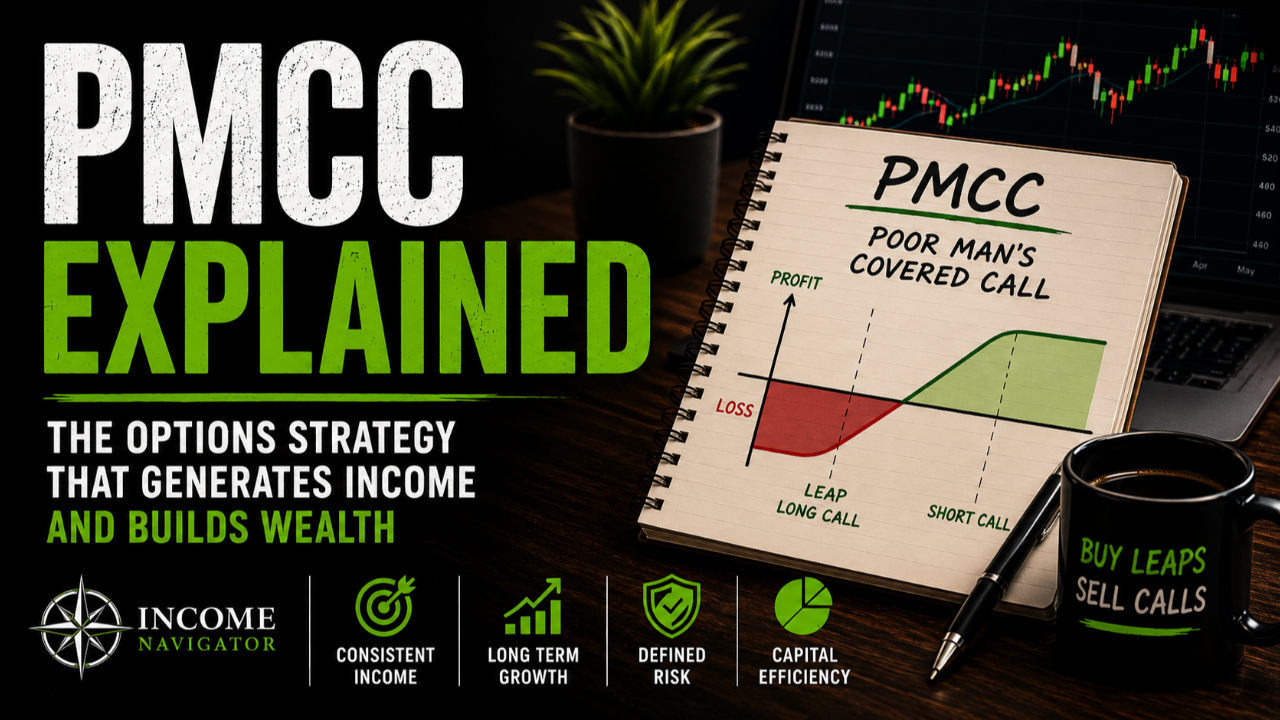
The poor man's covered call — the PMCC — is one of those strategies that sounds like a shortcut.
It isn't.
It's a real strategy with real rules. Trade it right, and you get the income profile of a covered call for about 20% of the capital. Trade it wrong, and you blow up faster than you would have if you'd just bought the stock.
Here's how it actually works, how to set it up, and the three mistakes that quietly kill PMCC accounts.
What a PMCC Actually Is
A poor man's covered call is a diagonal call spread. Two legs.
- Long leg: one deep-in-the-money LEAP call. Delta 0.80 or higher. 12+ months to expiration.
- Short leg: one out-of-the-money short call. 21–35 DTE. Around 20–30 delta.
The LEAP acts like 100 shares of stock. At delta 0.80, every $1 the stock moves, the LEAP moves about $0.80. Close enough.
Against that synthetic stock, you sell a shorter-dated call out-of-the-money. The short call collects premium every cycle — exactly like a regular covered call. The difference is you didn't have to tie up $18,000 in AAPL to do it.
Quick numbers using AAPL. Illustrative.
- Covered call: ~$18,000 of capital, ~$150 premium per cycle, ~0.8% ROI per cycle.
- PMCC: ~$3,500 of capital, ~$150 premium per cycle, ~4.3% ROI per cycle.
Same income. Very different capital efficiency.
One critical tradeoff: a PMCC has a time limit. The LEAP eventually expires. A share of stock doesn't.
Hold that thought. It's the whole reason people blow up PMCCs.
For the background, see our Covered Call guide and the Beginner's Guide to LEAPs.
Why PMCCs Work
Deep-ITM LEAPs have very little extrinsic value.
When a call is deep ITM, almost all of its price is intrinsic. The extrinsic portion is small. That means the LEAP loses very little to theta decay over time, and it moves nearly dollar-for-dollar with the stock.
You're not buying stock. You're buying a synthetic that behaves like 80 shares while costing you ~20% of what 100 shares would.
Then you sell a short-dated call against it. The short call decays fast (high theta). The LEAP barely decays (low theta). The net of those two flows is what pays you.
This is why delta matters. Buy a 0.60-delta LEAP and you're paying for too much extrinsic, the LEAP decays meaningfully, and the math stops working.
More on this in Delta Explained.
How to Pick the LEAP
This is where most PMCC traders get sloppy. Don't.
- Delta: 0.80 or higher. Less and you're paying for too much extrinsic. Much higher (0.90+) and you're paying for diminishing returns.
- Days to expiration: 12 months or more. We prefer 14–18 months. You want runway.
- Underlying: liquid, slow-moving, fundamentally sound. SPY, QQQ, AAPL, MSFT, GOOGL, JPM. Not meme stocks.
- Implied volatility: lower is better when you buy. You pay less for extrinsic, and if IV expands later, your LEAP gets a tailwind.
- Open interest: at least 100 contracts at your strike. Wide spreads on the LEAP cost you on every roll.
A bad LEAP entry is a bad PMCC for the entire life of the trade.
How to Pick the Short Call
The short call is the engine. It's where the PMCC actually pays you.
- Days to expiration: 21–35 DTE. Closer than 21 and gamma risk goes parabolic. Further than 35 and you give up the steepest part of the decay curve.
- Delta: 20–30. Lower = safer but less income. Higher = more income but more rolling and assignment risk.
- Strike: above your LEAP strike. Non-negotiable. We'll explain why in the mistakes section.
- Premium target: 1–2% of the LEAP's cost per cycle.
- Avoid earnings. The IV crush can help you but the gap risk can wreck you. Skip the cycle.
Same checklist every time. No instincts.
Management Rules — When to Do What
This is where the PMCC stops being a "strategy" and becomes a system. We wrote about the difference in Trading Strategies vs Trading Systems.
- Rule 1 — Close the short call at 30–50% of max profit. The last 50% of the premium is the slowest, most dangerous portion to collect. Take the win, redeploy.
- Rule 2 — Roll the short call when the stock touches the short strike. Up and out for a credit. Never roll for a debit to extend.
- Rule 3 — Roll the LEAP when it has less than 6 months remaining. You don't want to hold a LEAP into its accelerating theta decay window.
- Rule 4 — If the stock rips above your short strike before you can roll, accept the cap. That's the trade you signed up for.
- Rule 5 — If the stock drops hard, manage the short call, not the LEAP. The LEAP will hurt — that's normal. We covered this in The DPMCC Under Pressure. Don't panic on the LEAP. Keep selling short calls. The premium pays for the drawdown.
The 3 Mistakes That Quietly Kill PMCC Accounts
We've seen these three more often than every other PMCC mistake combined.
Mistake 1 — Selling the short call below the LEAP strike.
The cardinal sin. It creates a "broken" diagonal where, if the stock rips past your short strike, your loss can exceed the credit you collected.
Your LEAP strike defines your synthetic stock cost basis. If your short call strike is below the LEAP strike and you get assigned, you've locked in a loss of (LEAP strike − short strike) minus the credits you collected — a guaranteed loss that's almost always larger than the premium you took in.
The rule: short strike must always be above your LEAP strike. Always.
Mistake 2 — Letting the LEAP get too short-dated.
Below 6 months to expiration, theta decay accelerates and gamma rises. A LEAP that worked great at 14 months is a different animal at 4 months. It stops behaving like stock.
The fix is boring: roll it before it gets there.
Mistake 3 — Sizing the position like it's a single trade.
PMCCs feel cheap. That's the trap.
When the LEAP costs $3,500 instead of $18,000, the temptation is to run five at once. Now you have $17,500 of LEAP exposure across five names that probably move together. One bad market week and your "diversified" book moves down in lockstep.
Position size by risk, not by capital outlay. Our rule of thumb: cap any single PMCC at 5% of account, total PMCC exposure at 25%.
PMCC vs DPMCC — A Quick Preview
The standard PMCC is a static framework. Pick a LEAP. Sell a short call at 20–30 delta and 21–35 DTE. Manage by the rules. Repeat.
The DPMCC — the Dynamic Poor Man's Covered Call — takes that same structure and adds one layer.
The short call's strike is selected dynamically based on the prevailing market and volatility regime.
Bullish trend. Sideways chop. High-IV environment. Low-IV grind. Each regime calls for a different short-call strike. The static PMCC treats every cycle the same. The DPMCC doesn't.
That one change — dynamic strike selection — is the difference between a PMCC that's profitable on average and one that adapts to what the market is actually giving you.
The full regime framework, with the specific rules and triggers, is what we teach inside the DPMCC course at Income Navigator.
Before You Place Your First PMCC
Run through this:
- LEAP delta 0.80 or higher.
- LEAP DTE 12+ months.
- Underlying is liquid.
- Short call DTE 21–35.
- Short call delta 20–30.
- Short call strike above LEAP strike.
- No earnings before short call expiration.
- Position size ≤ 5% of account.
- Written exit plan: close at 30–50%, roll if breached.
If any of those are "no," you're not ready to send the order.
That's not us being strict. That's the difference between a PMCC that pays you for years and one that quietly drains the account.
Final Thoughts
The PMCC isn't a hack. It isn't a get-rich-quick trade. It's a real options strategy that, traded with discipline, gives you the income profile of a covered call at a fraction of the capital.
Same income profile. 80% less capital. One time limit you have to respect.
If you trade it like a system, you'll do well. If you trade it like a clever shortcut, the market will teach you the difference.
Stay small. Master the mechanics. Then scale.
Want the Dynamic Version?
The PMCC is the foundation. The DPMCC — the Dynamic Poor Man's Covered Call — is the regime-aware version we trade and teach inside Income Navigator.
If you want the full system with dynamic strike selection, rolling mechanics, portfolio construction, and real trade examples:
Check out the DPMCC course at Income Navigator
Stay connected with news and updates!
Join our mailing list to receive the latest news and updates from our team.
Don't worry, your information will not be shared.
We hate SPAM. We will never sell your information, for any reason.
