
Cash-Secured Put Assignment: What Happens Next?
Aug 30, 2026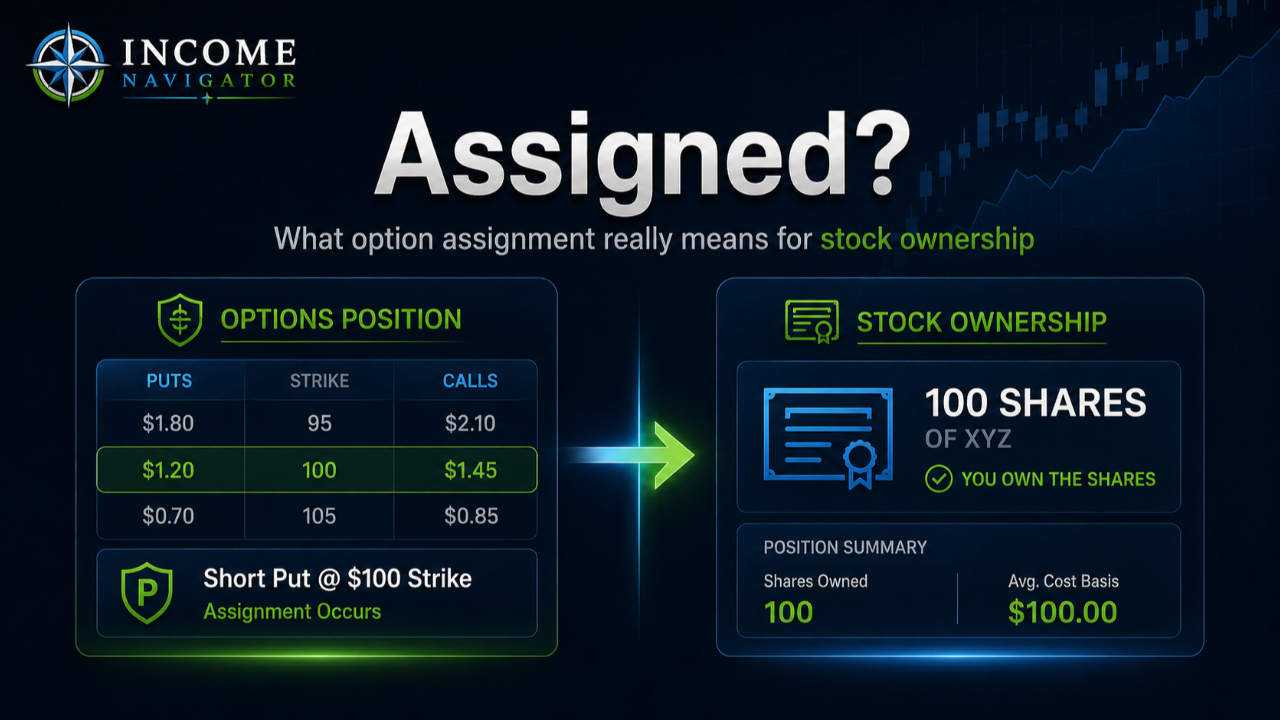
You sold a cash-secured put because you were comfortable owning the stock at the strike price.
Then the stock starts falling.
Your short put moves into the money.
The premium you collected no longer feels like the main part of the trade.
Now there is a different question:
For many options traders, assignment feels like the moment a trade went wrong.
They sold the put for income.
They expected it to expire worthless.
They did not expect to wake up owning 100 shares of stock.
But assignment is not a surprise built into the strategy.
It is the obligation you accepted when you sold the put.
A cash-secured put is not just a premium trade. It is an agreement to buy stock if the option is assigned.
That does not make assignment a failure.
But it does mean you need to understand what happens next before you enter the position.
What Assignment Actually Means
When you sell a put option, you take on the obligation to buy the underlying stock at the strike price if you are assigned.
Each standard equity option contract represents 100 shares.
If you sell one $50 put and are assigned, you buy 100 shares at $50 per share.
That means $5,000 of cash is used to purchase the shares.
The cash was supposed to be available from the beginning.
That is what makes the trade cash-secured.
In exchange for accepting that obligation, you received premium when you sold the option.
The premium lowers your effective cost basis.
It does not eliminate the risk that the stock may continue falling after assignment.
📖 Related Reading
Start with the mechanics of the put contract.
Before worrying about assignment, understand the obligation a put seller accepts and how strike price and expiration shape the position.
Read Put Options Explained: Buying & Selling Put Options for Beginners →
A Simple Assignment Example
Imagine a stock is trading at $55.
You decide that you would be comfortable owning it at $50.
You sell one $50 cash-secured put and collect $1.00 in premium.
The position
- Stock price when entered: $55
- Put strike: $50
- Premium collected: $1.00 per share
- Total premium collected: $100
- Potential stock purchase: 100 shares at $50
- Cash required if assigned: $5,000
Effective basis if assigned: approximately $49 per share before commissions, fees, and taxes.
If the stock is below $50 when the position is assigned, you purchase 100 shares at $50.
Because you collected $1.00 in premium, your effective basis is approximately $49 per share.
If the stock is trading at $48, you are below your effective basis.
If the stock is trading at $40, you are much further below your effective basis.
The premium helped.
But it did not prevent the stock from falling.
It does not change the fact that the stock can continue moving against you after you own it.
Assignment Is a Known Outcome
One of the biggest mistakes traders make is treating assignment as something unexpected.
They sell a put because the premium looks attractive.
Then the stock falls.
Then they are surprised that they may have to buy it.
But that was always part of the contract.
The short put seller is accepting the obligation to buy shares at the strike price if assigned.
That is why the decision should be made before the trade is opened.
📖 Related Reading
Decide whether selling the put fits your plan before you enter.
A cash-secured put and a limit order can target a similar stock price, but they create very different obligations and outcomes.
Read Cash-Secured Put vs. Limit Order: Which Is Better for Buying Stock? →
Before selling a put, ask yourself:
- Would I be comfortable owning 100 shares at this strike?
- Do I have enough cash available if assignment occurs?
- Would the shares create too much exposure in my portfolio?
- Would I still want to own this stock if it fell another 10% or 20%?
- Am I selling this put because I like the stock, or only because I like the premium?
If you cannot answer those questions clearly, you may not be ready to sell the put.
The best time to decide whether assignment is acceptable is before you collect the premium.
Can You Be Assigned Before Expiration?
Yes.
Short American-style equity options can be assigned before expiration.
That does not mean it happens constantly.
But it is part of the risk you accept when you sell a short put.
Assignment becomes more relevant when a put is in the money, particularly when there is very little time value remaining.
The important point is not to predict the exact moment assignment might occur.
The important point is to be ready for the possibility.
If you sell a cash-secured put, the cash should already be available to purchase the shares.
That way, assignment does not create a scramble.
It simply turns the reserved cash into stock ownership.
Why Strike Selection Matters
Assignment risk starts with the strike you choose.
A higher strike generally produces more premium.
It also means you are agreeing to buy the stock at a higher price.
A lower strike may produce less premium.
But it can give the stock more room to decline before the position moves into the money.
This is where many traders look at delta.
Delta can be useful for comparing strikes and understanding how an option may respond to a move in the underlying stock.
But delta does not tell you whether you will be happy owning the stock after a sharp decline.
It does not know how much of your portfolio is already exposed to the same sector.
And it does not remove assignment risk.
📖 Related Reading
Delta helps compare strikes. It does not guarantee outcomes.
Delta is useful for understanding an option’s sensitivity and comparing strikes, but it is not a substitute for stock selection or position sizing.
It is the price at which you may become a shareholder.
When Assignment May Be Acceptable
Assignment may be completely acceptable when the trade was structured correctly from the beginning.
You may still want to own the stock.
The position size may still fit your portfolio.
The original reason you were willing to buy at the strike may still be intact.
And you may have reserved the cash specifically for that outcome.
In that case, assignment is not necessarily a problem.
It is simply the stock-purchase outcome you accepted when you sold the put.
That does not mean the position will immediately become profitable.
It means the ownership decision was part of the original plan.
When Assignment Becomes a Problem
Assignment becomes more difficult when the trade was not planned properly.
Maybe the stock dropped because the business outlook changed.
Maybe you sold several contracts and the resulting share position is too large.
Maybe you have other positions in the same sector that are also moving lower.
Maybe the original trade was based entirely on a large premium.
Or maybe you were comfortable owning the stock at the strike only when it was trading higher.
That last one matters.
Many traders say they are comfortable owning a stock at a lower price.
Then the stock actually reaches that price.
And they discover they were only comfortable in theory.
A position is not properly sized if assignment would force you to make a decision you are not financially or emotionally prepared to make.
That is why position sizing matters before the trade is entered, not after assignment occurs.
📖 Related Reading
Position size changes the entire trade.
The premium may look manageable, but the capital commitment behind a cash-secured put can become a portfolio problem when the position is too large.
Read Position Sizing: How Trade Size Changes Your Psychology →
Should You Sell Covered Calls After Assignment?
After assignment, you own 100 shares per contract.
That means you may have the ability to sell covered calls against those shares.
This is the transition behind the Wheel strategy.
You sell a cash-secured put.
If assigned, you own the stock.
Then you may sell calls against the shares if that approach fits your plan.
But selling covered calls is not an automatic solution for every assigned put.
It does not erase the loss created by a falling stock.
It does not guarantee that the stock will recover.
And it does not make a position appropriate if you no longer want to own the shares.
Covered calls should be a deliberate choice, not an automatic reaction.
📖 Related Reading
Understand the Wheel before using it as the next step.
Selling covered calls after assignment can fit a broader Wheel strategy, but only when you still want to own the shares and the position fits your plan.
Read Wheel Strategy Explained: Monthly Income with Options →
What Should You Do After Assignment?
There is no single answer that fits every assigned put.
The right decision depends on the stock, the size of the position, your portfolio, and whether your original reason for owning the shares still makes sense.
But the first step is simple.
Do not react emotionally just because the position changed from an option to stock.
Review the facts.
- What is your effective basis after the premium received?
- Do you still want to own the stock?
- Is the position size still appropriate for the portfolio?
- Has the reason for owning the stock changed?
- Do you want to hold the shares, reduce exposure, or consider covered calls?
Assignment does not require an immediate emotional decision.
It requires an honest review of whether the stock ownership still fits the plan.
Assignment Is Not Failure. Unplanned Risk Is.
Cash-secured put assignment is often treated as something traders should avoid at all costs.
That is the wrong way to look at it.
Assignment is one of the possible outcomes of the strategy.
It can be acceptable when you chose the stock carefully, selected a strike you could live with, reserved the necessary capital, and sized the position appropriately.
The real danger is selling puts without a plan.
Chasing premium.
Ignoring position size.
Assuming assignment will never happen.
And then discovering that the obligation is much larger than you expected.
The failure is accepting an obligation you were never prepared to handle.
Learn to Think Beyond the Trade
At Income Navigator, we do not focus on chasing the highest premium or blindly following trade alerts.
We focus on understanding the structure of the trade, the risk being taken, position sizing, volatility, portfolio exposure, and how each position fits within an overall trading plan.
Inside the Income Navigator community, members can follow real options trades and see the thinking behind entries, adjustments, exits, and risk-management decisions as they happen.
If you want to build a more disciplined approach to options trading instead of simply chasing premium, learn more about Income Navigator here.
Options education, real-world trade management, and a community focused on the process behind the trade.
Options trading involves substantial risk of loss and is not appropriate for all investors. Past performance is not indicative of future results. This content is for educational purposes only and should not be considered investment, legal, or tax advice.
Stay connected with news and updates!
Join our mailing list to receive the latest news and updates from our team.
Don't worry, your information will not be shared.
We hate SPAM. We will never sell your information, for any reason.
