
Cash-Secured Put vs. Limit Order: Which Is Better for Buying Stock?
Aug 30, 2026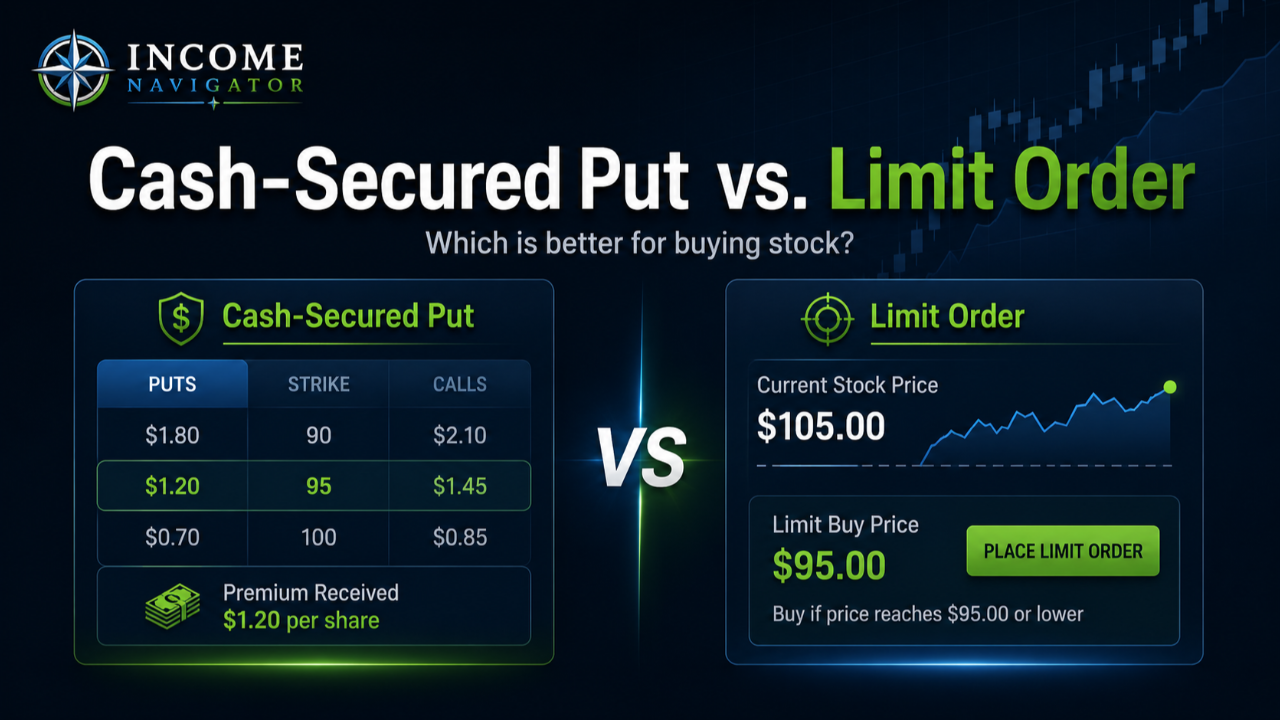
You have decided there is a stock you would like to own.
It is trading at $105.
You would be comfortable buying it at $95.
Now you have two choices.
Or do you sell a $95 cash-secured put and collect premium while you wait?
On the surface, the cash-secured put can look like the obvious choice.
You may get to buy the stock at the same $95 price.
But unlike a limit order, you collect premium for taking on the obligation.
That sounds better.
Sometimes it is.
But the premium does not make the cash-secured put a free upgrade over a limit order.
It changes the trade.
It adds expiration, assignment, implied volatility, and management decisions that a simple limit order does not have.
A cash-secured put is not just a limit order that pays you while you wait.
It is an options position.
And it should be evaluated like one.
The Basic Difference
A limit order is straightforward.
You tell your broker that you are willing to buy a stock at a specific price.
If the stock trades at that price and your order is filled, you own the shares.
If it does not, you do not.
There is no premium collected. There is no expiration date. There is no option contract to manage.
A cash-secured put works differently.
You sell a put option at a strike price where you would be comfortable owning the stock. In exchange for collecting premium, you take on the obligation to buy 100 shares at that strike price if you are assigned.
Limit Order
- You choose the price where you want to buy.
- If the order fills, you buy the shares.
- You collect no premium.
- You have no options position to manage.
- Your order can remain open until you cancel it or it expires based on your brokerage settings.
Cash-Secured Put
- You choose a strike price where you may be willing to buy.
- You collect premium upfront.
- You may be assigned 100 shares per contract.
- The contract has an expiration date.
- The position can gain or lose value before expiration as the stock price and implied volatility change.
The strike price and the limit price may be the same.
The experience of owning the position is not.
Why the Cash-Secured Put Looks More Attractive
The appeal is obvious.
If you are already willing to buy a stock at $95, why not sell a $95 put, collect premium, and potentially lower your effective purchase price?
That logic can make sense.
Suppose you sell one $95 put and collect $1.50 in premium.
You receive $150 because each standard equity option contract represents 100 shares.
If you are assigned at $95, your effective basis is approximately $93.50 per share before commissions, fees, and taxes.
You may be able to buy a stock at a price you already liked, while collecting premium that reduces your effective basis.
But that is only one possible outcome.
The mistake is assuming that premium makes the cash-secured put automatically better than the limit order.
It does not.
It simply means you are being paid to accept a more complicated obligation.
A Cash-Secured Put Can Miss the Trade
This is one of the biggest differences traders overlook.
With a limit order, if the stock trades at your target price and your order is filled, you own the shares.
With a cash-secured put, the stock can fall near your strike, reverse higher, and never leave you with the stock.
You may keep the premium.
But you may also miss the entry you wanted.
Imagine a stock trades at $105.
You want to own it at $95.
You sell a $95 put.
The stock falls to $95.20 during a market selloff, then rallies to $112 before expiration.
Your put may expire worthless.
You keep the premium.
But you do not own the stock.
Your limit order, assuming it filled at $95, would have put you into the shares.
The cash-secured put can produce income without producing the stock ownership you originally wanted.
That is not necessarily bad.
But it is different.
And you should understand the difference before choosing the strategy.
The Premium Is Compensation for Risk
When you collect premium from selling a put, the market is not giving you free money for doing something you were already going to do.
You are accepting risk.
The stock may fall much farther than your strike.
Implied volatility may expand.
Your short put can increase in value even before the stock reaches the strike.
And if the stock moves sharply lower, the premium collected may be small compared with the loss you would face if you are assigned shares or close the position.
High premium often exists for a reason.
It may reflect earnings risk, a recent selloff, liquidity concerns, company-specific uncertainty, or a market expectation for larger movement.
For a deeper discussion of why expensive options are not automatically attractive short-premium opportunities, read High IV Options: Why Higher Premium Means Higher Risk.
It is compensation for accepting the possibility that the stock falls far below the price where you agreed to buy it.
That does not make cash-secured puts bad.
It means you should not judge the trade only by the credit you receive.
Strike Selection Still Matters
Whether you use a limit order or sell a put, the price you choose matters.
But selling a put adds another layer to the decision.
You are not only choosing a price where you would buy the stock.
You are choosing how much premium you are willing to accept in exchange for the possibility of assignment, the duration of the obligation, and the risk that the stock moves sharply lower.
This is where many traders start looking at delta.
Delta can help compare option strikes and give you a rough sense of how an option may respond to changes in the stock price.
It can be useful.
But it is not a complete risk measurement.
A 15-delta put on a broad-market ETF may behave very differently from a 15-delta put on a speculative stock heading into earnings.
We break down that distinction in What Delta Actually Tells You.
A lower delta may reduce the probability of assignment. It does not eliminate the risk of a bad outcome.
If you want a practical framework for using delta specifically when selecting a cash-secured put strike, read What Delta Should You Sell Cash-Secured Puts At?.
Assignment Is Not Automatically a Failure
Assignment means you buy 100 shares per contract at the strike price.
If you sold one $95 put, you may be assigned 100 shares at $95 each.
The premium collected reduces your effective basis.
But now you own the stock.
If that was your plan from the beginning, assignment may be completely acceptable.
It may even be the outcome you wanted.
But if the stock has changed, the market environment has changed, or the position has become too large for your portfolio, assignment can feel very different than it did when you initially sold the put.
That is why the decision must be made before the trade.
Do not sell the put because you are comfortable owning the stock at $95 today if you know you will panic if it trades at $85 tomorrow.
If you are assigned and still want to own the shares, you may choose to sell covered calls against them. That is the transition that begins the Wheel strategy.
If you want a detailed walkthrough of what assignment means, how your effective basis changes, and what choices you have after you own the shares, read Cash-Secured Put Assignment: What Happens Next?.
But selling covered calls only makes sense when you still want to own the stock and the shares continue to fit your overall plan.
Position Size Can Change the Answer
A $95 cash-secured put represents a potential obligation to buy $9,500 worth of stock per contract.
That may be reasonable for one portfolio.
It may be far too large for another.
This is where traders get into trouble.
They see the premium.
They like the stock.
They sell several contracts.
Then the stock falls, assignment becomes likely, and they realize they have committed far more capital than they were prepared to deploy.
The trade may have looked manageable when they focused on the $150, $300, or $600 in premium.
It looks different when they focus on the $9,500, $19,000, or $38,000 in potential stock exposure.
The premium may be small. The obligation is not.
That is why position size matters more than finding the highest credit.
We discuss that relationship in more detail in Position Sizing: How Trade Size Changes Your Psychology.
When a Limit Order May Make More Sense
A limit order may be the simpler and better choice when:
- You want to own the shares if the stock reaches your target price.
- You do not want an expiration date or an options position to manage.
- You do not want to risk missing a brief move through your target price.
- You are not being paid enough premium to justify the additional obligation.
- You are not comfortable with assignment, rolling, or managing a short option position.
- You want a direct stock entry rather than an income trade.
There is nothing wrong with using a limit order.
Sometimes the simplest way to express your view is the best one.
When a Cash-Secured Put May Make More Sense
A cash-secured put may be appropriate when:
- You are genuinely willing to own 100 shares at the strike price.
- You have the cash available if assignment occurs.
- You understand how expiration, assignment, and implied volatility affect the trade.
- You are being paid a premium that you believe is attractive relative to the risk.
- You are comfortable with the possibility that the stock may not be assigned even if it trades near your target.
- You have a plan for profits, losses, assignment, and portfolio exposure.
The cash-secured put is not better because it produces premium.
It is better only when the added obligation fits your plan.
The Better Question
The wrong question is:
The better question is:
That is the question that keeps the trade grounded in process instead of excitement.
A limit order is a direct decision to buy stock at a price.
A cash-secured put is a decision to accept a stock-purchase obligation in exchange for premium.
Neither is automatically better.
But they are not the same trade.
But the obligation matters more.
Learn to Think Beyond the Trade
At Income Navigator, we do not focus on chasing the highest premium or blindly following trade alerts.
We focus on understanding the structure of the trade, the risk being taken, position sizing, volatility, portfolio exposure, and how each position fits within an overall trading plan.
Inside the Income Navigator community, members can follow real options trades and see the thinking behind entries, adjustments, exits, and risk-management decisions as they happen.
If you want to build a more disciplined approach to options trading instead of simply chasing premium, learn more about Income Navigator here.
Options education, real-world trade management, and a community focused on the process behind the trade.
Options trading involves substantial risk of loss and is not appropriate for all investors. Past performance is not indicative of future results. This content is for educational purposes only and should not be considered investment, legal, or tax advice.
Stay connected with news and updates!
Join our mailing list to receive the latest news and updates from our team.
Don't worry, your information will not be shared.
We hate SPAM. We will never sell your information, for any reason.
