
Cash-Secured Put Risks: What Most Traders Miss
Sep 09, 2026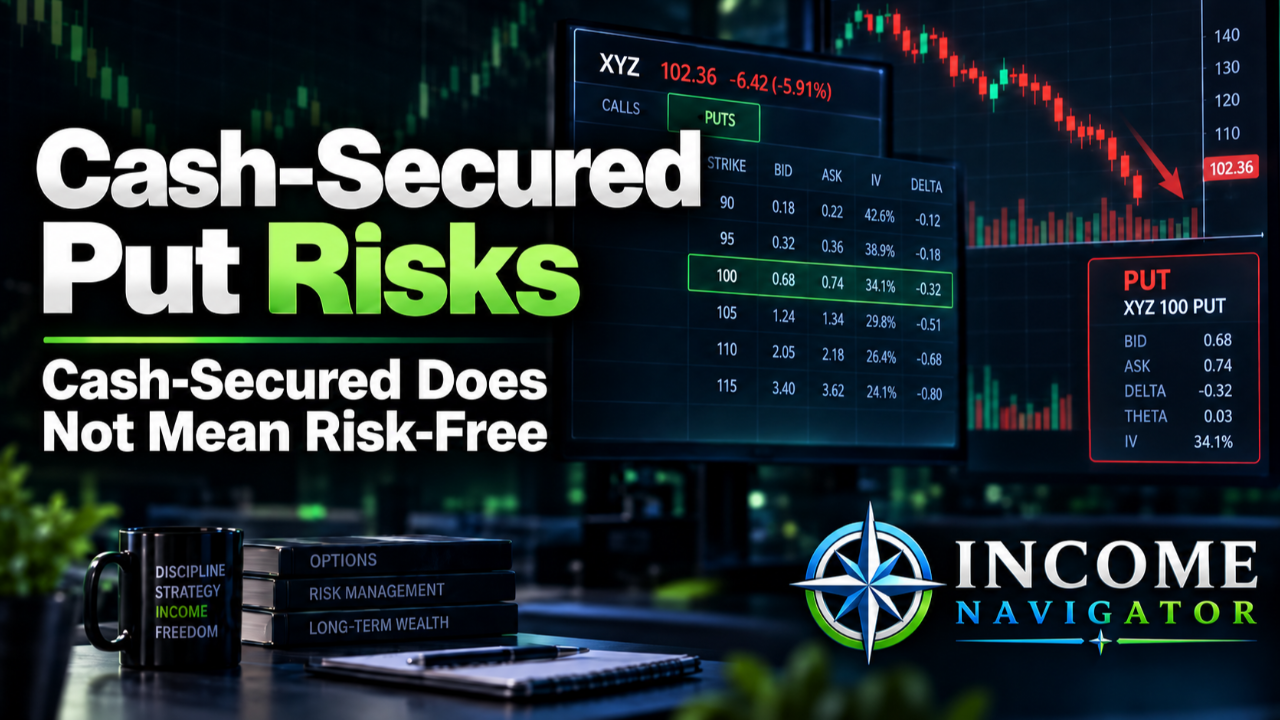
The phrase cash-secured put sounds safer than it really is.
You sell a put option.
You keep enough cash in the account to buy 100 shares if you are assigned.
You collect premium while you wait.
And because the position is backed by cash, it can feel like the risk has already been handled.
But cash-secured does not mean risk-free.
It simply means you have the cash available to meet the obligation if the option is assigned.
The stock can still fall.
The position can still become too large.
Implied volatility can still expand.
And the premium you collected can become very small compared with the stock exposure you agreed to take on.
It only makes sure you have the cash available if you are required to buy the shares.
That distinction matters.
Because many traders look at a cash-secured put as an income trade first and a stock-purchase obligation second.
The better approach is the opposite.
A cash-secured put is a stock-risk position with premium attached.
The Premium Is Small Compared With the Potential Stock Exposure
The maximum possible profit on a short put is limited to the premium you collect.
If you sell one put for $1.00, you collect $100.
That is the most the trade can make before commissions, fees, and taxes.
But the obligation behind the trade can be much larger.
If the strike is $50, one contract represents the possibility of buying $5,000 worth of stock.
If the stock falls sharply, the $100 premium may provide only a small offset against the decline.
Example: One $50 cash-secured put
- Strike price: $50
- Premium collected: $1.00 per share
- Total premium collected: $100
- Potential stock purchase: 100 shares at $50
- Cash required if assigned: $5,000
- Effective basis after premium: approximately $49 per share before commissions, fees, and taxes
If the stock falls to $40 after assignment, the premium helped. But it did not prevent a meaningful decline in the value of the shares.
This is the risk traders need to see clearly.
The premium may look attractive on the option chain.
The potential stock exposure is what determines the real size of the decision.
📖 Related Reading
High premium can signal higher risk.
Expensive options are not automatically attractive short-premium opportunities. The premium may be higher because the market expects a larger move or more uncertainty.
Read High IV Options: Why Higher Premium Means Higher Risk →
Assignment Can Create More Stock Exposure Than You Expected
Every standard equity option contract represents 100 shares.
That may not sound significant when you are looking at a credit on an option chain.
But the actual dollar commitment can add up quickly.
One $50 put represents $5,000 of potential stock exposure.
Three contracts represent $15,000.
Five contracts represent $25,000.
And that is before considering any other positions you may already hold.
Assignment is not automatically a failure.
It may be completely acceptable if you wanted to own the stock at the strike price, reserved the cash, and sized the trade appropriately.
But assignment becomes a problem when the position was too large from the beginning.
Or when the stock was selected because the premium looked attractive rather than because you genuinely wanted to own it.
📖 Related Reading
Assignment changes the position. It does not have to change the plan.
Assignment turns the short-put obligation into stock ownership. The important question is whether you were prepared for that outcome before entering the trade.
Lower Delta Does Not Mean No Risk
Many traders use delta to compare cash-secured-put strikes.
That can be useful.
A lower-delta put is generally farther out of the money and may have a lower chance of finishing in the money at that moment.
But lower delta does not mean the trade is safe.
Stocks can gap lower.
Earnings can surprise.
Unexpected news can change the outlook for a company or an entire sector.
And implied volatility can expand at the same time the stock moves against you.
A put that looked comfortably out of the money when you entered can become deeply in the money very quickly.
Delta is a snapshot of the option at that moment.
It is not a promise about what the market will do next.
📖 Related Reading
Delta helps compare strikes. It does not guarantee outcomes.
Use delta as one input when selecting a strike, alongside stock quality, volatility, position size, and your willingness to own shares at that price.
Position Size Can Turn One Trade Into a Portfolio Problem
One cash-secured put may be manageable.
Several cash-secured puts on the same stock can create a very different level of exposure.
Several puts on stocks in the same sector can create another problem entirely.
The positions may look separate in the account.
But if they are all exposed to the same economic trend, the same sector weakness, or the same market selloff, they can all move against you at the same time.
This is how traders can become overexposed without realizing it.
They focus on each premium individually.
They do not add up the potential stock purchases behind all of the contracts.
The risk is not just the put you sold. The risk is the combined obligation across the entire portfolio.
Before entering a position, consider the actual stock exposure if every short put were assigned at the same time.
That may be an unlikely outcome.
But it is the scenario that tells you whether the portfolio has enough flexibility.
📖 Related Reading
Position size changes the entire trade.
The premium may look manageable, but the capital commitment behind a cash-secured put can become a portfolio problem when the position is too large.
Read Position Sizing: How Trade Size Changes Your Psychology →
The Wheel Is Not an Automatic Repair Strategy
When a cash-secured put is assigned, many traders immediately think about selling covered calls.
That can be a reasonable next step when you still want to own the stock and the position fits your plan.
But selling covered calls does not erase a loss from a falling stock.
It does not guarantee that the stock will recover.
And it does not make an oversized or unwanted position acceptable.
The Wheel is a strategy.
It is not an automatic repair plan for every cash-secured put that moves against you.
Before selling calls after assignment, ask whether you still want to own the shares and whether the position belongs in the portfolio.
What Cash-Secured Actually Means
Cash-secured means that you set aside enough capital to buy the shares if you are assigned.
That is important.
It prevents the position from relying on borrowed money to meet the basic stock-purchase obligation.
But it does not make the trade conservative in every circumstance.
A cash-secured put can still have substantial risk when:
- The underlying stock is highly volatile.
- The strike price is too high relative to the risk you are willing to accept.
- The position is too large for the portfolio.
- Multiple puts create concentrated exposure to the same stock or sector.
- The premium is collected without a clear plan for assignment or a significant decline.
Cash collateral is a form of preparation.
It is not a substitute for stock selection, position sizing, diversification, or risk management.
A Cash-Secured Put Risk Checklist
Before selling a cash-secured put, ask:
- Would I be comfortable owning 100 shares at this strike price?
- Do I have the full cash requirement available if assignment occurs?
- How much stock exposure would this create if I am assigned?
- How much correlated exposure do I already have in this sector or theme?
- Does the premium justify the downside risk I am accepting?
- Could implied volatility expand further if the stock moves lower?
- Am I choosing the position size based on total exposure rather than the premium collected?
- What will I do if the stock falls materially below the strike?
If those answers are unclear, the trade may not be ready.
Cash-Secured Does Not Mean Risk-Free
Cash-secured puts can be useful tools for traders who are willing to own stock at a specific price.
They can generate premium.
They can lower the effective basis if assignment occurs.
And they can fit inside a disciplined options-income strategy.
But they should not be treated as easy income.
The premium is limited.
The stock exposure can be significant.
And the real risk is not whether the position is cash-secured.
It is whether the stock, strike, premium, position size, and portfolio exposure all make sense together.
It means you are prepared to buy the stock. You still need to decide whether owning it at that price is a risk worth taking.
Learn to Think Beyond the Trade
At Income Navigator, we do not focus on chasing the highest premium or blindly following trade alerts.
We focus on understanding the structure of the trade, the risk being taken, position sizing, volatility, portfolio exposure, and how each position fits within an overall trading plan.
Inside the Income Navigator community, members can follow real options trades and see the thinking behind entries, adjustments, exits, and risk-management decisions as they happen.
If you want to build a more disciplined approach to options trading instead of simply chasing premium, learn more about Income Navigator here.
Options education, real-world trade management, and a community focused on the process behind the trade.
Options trading involves substantial risk of loss and is not appropriate for all investors. Past performance is not indicative of future results. This content is for educational purposes only and should not be considered investment, legal, or tax advice.
Stay connected with news and updates!
Join our mailing list to receive the latest news and updates from our team.
Don't worry, your information will not be shared.
We hate SPAM. We will never sell your information, for any reason.
