
What Delta Should You Sell Cash-Secured Puts At?
Sep 06, 2026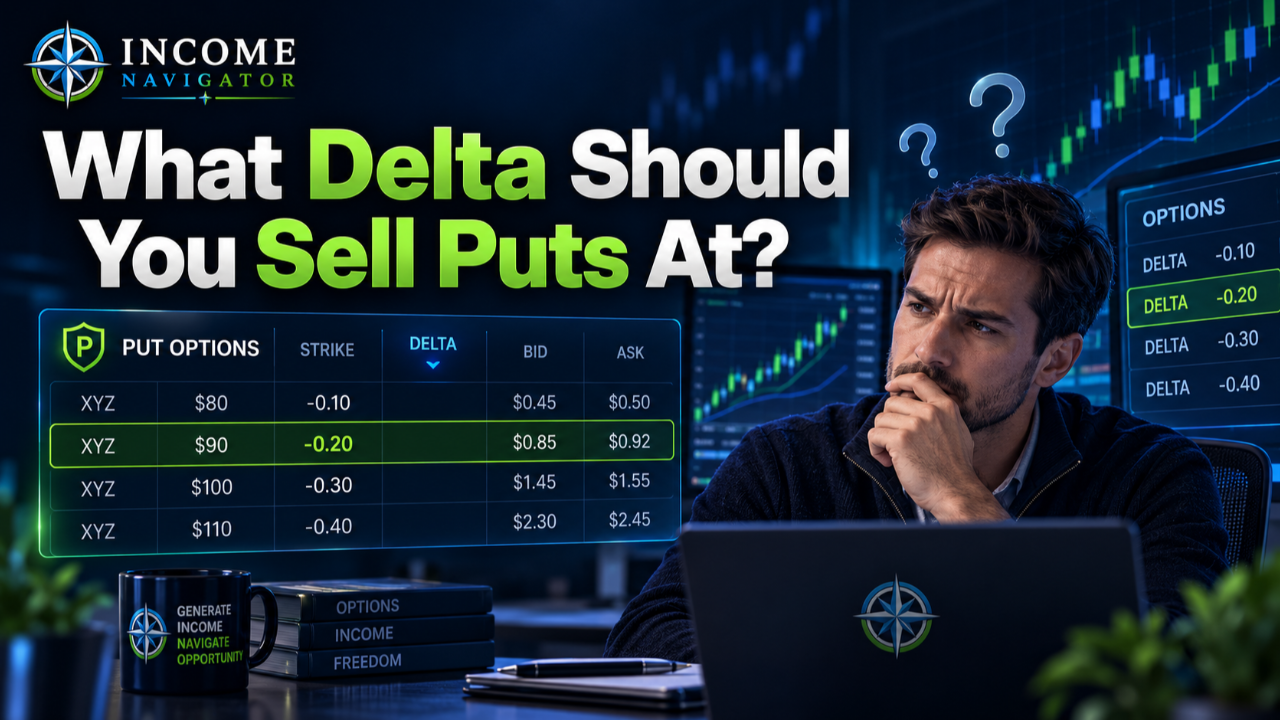
One of the first questions traders ask when selling cash-secured puts is simple:
It sounds like there should be one clean answer.
Sell the 10 delta if you want safety.
Sell the 20 delta if you want more premium.
Sell the 30 delta if you are comfortable taking more assignment risk.
But that way of thinking can become dangerous quickly.
Delta is useful.
It can help you compare strikes. It can help you understand how an option may respond when the stock moves. And it can give you a rough sense of how far away a strike is from the current stock price.
But delta does not tell you whether you would actually be comfortable owning the stock at that strike.
It does not tell you whether the position is too large for your portfolio.
And it does not tell you whether the premium is attractive relative to the risk you are accepting.
Delta is a tool for choosing a strike. It is not a substitute for having a plan.
What Delta Actually Tells You
Delta is often used as a shortcut for thinking about an option.
A 0.20 delta put is commonly described as having roughly a 20% chance of expiring in the money.
A 0.30 delta put is commonly described as having roughly a 30% chance of expiring in the money.
That can be a useful mental shortcut.
But it is still a shortcut.
Delta changes as the stock price changes, time passes, and implied volatility changes.
It is not a guarantee that the option will or will not finish in the money.
And it does not tell you what happens if the stock moves sharply lower after you have been assigned.
For a deeper explanation of what delta means and where traders often misuse it, read What Delta Actually Tells You.
It cannot decide whether the stock, strike, position size, and premium make sense for your portfolio.
Start With the Stock, Not the Delta
The first question should not be:
The first question should be:
That is the foundation of a cash-secured put.
When you sell a put, you are accepting the obligation to buy 100 shares at the strike price if assigned.
The premium lowers your effective basis.
But it does not change the fact that you may become a shareholder.
If you would not want the stock at the strike price, the delta does not solve that problem.
A 10-delta put can still become a bad trade if the stock collapses.
A 30-delta put can be completely acceptable if you genuinely want to own the stock at that price and the position fits your plan.
The strike should make sense as a stock-purchase decision before it makes sense as an options trade.
A Lower Delta Does Not Mean No Risk
Lower-delta puts are generally farther out of the money.
That often means less premium.
It may also mean a lower probability of assignment at that moment.
But lower delta does not mean the trade is safe.
It does not mean the stock cannot move sharply lower.
It does not mean implied volatility cannot expand.
And it does not mean a position cannot become painful if it is too large.
Imagine two different 15-delta puts.
Put A
- Liquid broad-market ETF
- No company-specific earnings event
- Deep options market with tight spreads
- One small position in a diversified portfolio
Put B
- Highly volatile individual stock
- Earnings approaching
- Wide option spreads
- Large position relative to the portfolio
Both positions may show the same delta.
They are not necessarily the same risk.
The underlying stock, the volatility environment, liquidity, upcoming events, and position size all matter.
This is why high implied volatility should not automatically make a short put more attractive. High premium may reflect a real increase in risk.
For more on that relationship, read High IV Options: Why Higher Premium Means Higher Risk.
The Tradeoff Between Premium and Assignment Risk
When you sell a put closer to the current stock price, you usually collect more premium.
But you are also choosing a strike where assignment is more likely if the stock declines.
When you sell a put farther out of the money, you generally collect less premium.
But you give the stock more room to move before the position is threatened.
That is the basic tradeoff.
Higher-Delta Put
- Typically closer to the current stock price
- Usually produces more premium
- Generally has a greater chance of finishing in the money
- Creates a higher potential purchase price if assigned
Lower-Delta Put
- Typically farther from the current stock price
- Usually produces less premium
- Generally has a lower chance of finishing in the money at that moment
- Creates a lower potential purchase price if assigned
Neither choice is automatically better.
The better strike is the one that fits the stock you are willing to own, the premium you are receiving, and the risk you are prepared to accept.
Do Not Use Delta as a Promise
One of the most dangerous habits in options trading is treating delta as if it guarantees an outcome.
A trader sees a 15-delta put and thinks:
That may feel comforting.
But markets do not move in smooth, predictable lines.
Stocks can gap lower.
Earnings can surprise.
Volatility can expand.
And a position that looked far out of the money at entry can become deeply in the money very quickly.
Delta is a snapshot.
It is not a contract with the market.
The market does not care what delta you sold when the trade was opened.
It only cares where the stock is now.
Position Size Can Matter More Than Delta
A trader can choose a reasonable strike and still create a bad position.
That usually happens through size.
Suppose two traders each sell a 20-delta put.
One sells a single contract that represents a manageable amount of capital.
The other sells multiple contracts and creates a position large enough that assignment would dominate the portfolio.
They used the same delta.
They did not take the same risk.
This is why options traders need to think about the total exposure behind the contract, not only the premium on the option chain.
A cash-secured put can require a meaningful commitment of capital.
That commitment may be acceptable.
But it needs to fit the portfolio.
For more on how trade size affects decision-making, read Position Sizing: How Trade Size Changes Your Psychology.
The position still has to fit your available capital, your portfolio, and your ability to manage a drawdown.
Think About Assignment Before You Sell
When you choose a put strike, you are choosing more than a premium amount.
You are choosing a possible stock purchase price.
If the put is assigned, you buy 100 shares per contract at that strike price.
The premium received reduces the effective basis.
But it does not make a stock you do not want to own suddenly attractive.
Before selling the put, ask:
- Would I be comfortable owning 100 shares at this strike price?
- Do I have the cash available if assignment occurs?
- Would assignment create too much exposure to one stock or sector?
- Does the premium justify the additional obligation?
- What will I do if the stock falls significantly below the strike?
If you cannot answer those questions clearly, you may not be ready to sell the put.
If you want a detailed walkthrough of what assignment means and the choices you have after it happens, read Cash-Secured Put Assignment: What Happens Next?.
Delta Is One Input, Not the Strategy
There is no universal delta that every trader should sell.
The right strike depends on the stock, your willingness to own it, the premium available, the volatility environment, your capital, and your broader portfolio exposure.
Delta can help organize that decision.
It can help you compare strikes.
It can help you understand the tradeoff between premium and distance from the current stock price.
But it cannot make the decision for you.
And it cannot rescue a trade that was poorly selected, oversized, or entered without a management plan.
The goal is to choose a strike where the premium, the possible stock purchase, and the portfolio risk all make sense together.
Learn to Think Beyond the Trade
At Income Navigator, we do not focus on chasing the highest premium or blindly following trade alerts.
We focus on understanding the structure of the trade, the risk being taken, position sizing, volatility, portfolio exposure, and how each position fits within an overall trading plan.
Inside the Income Navigator community, members can follow real options trades and see the thinking behind entries, adjustments, exits, and risk-management decisions as they happen.
If you want to build a more disciplined approach to options trading instead of simply chasing premium, learn more about Income Navigator here.
Options education, real-world trade management, and a community focused on the process behind the trade.
Options trading involves substantial risk of loss and is not appropriate for all investors. Past performance is not indicative of future results. This content is for educational purposes only and should not be considered investment, legal, or tax advice.
Stay connected with news and updates!
Join our mailing list to receive the latest news and updates from our team.
Don't worry, your information will not be shared.
We hate SPAM. We will never sell your information, for any reason.
