
How to Trade Short Strangles: Risk, Strike Selection, and Management
May 29, 2025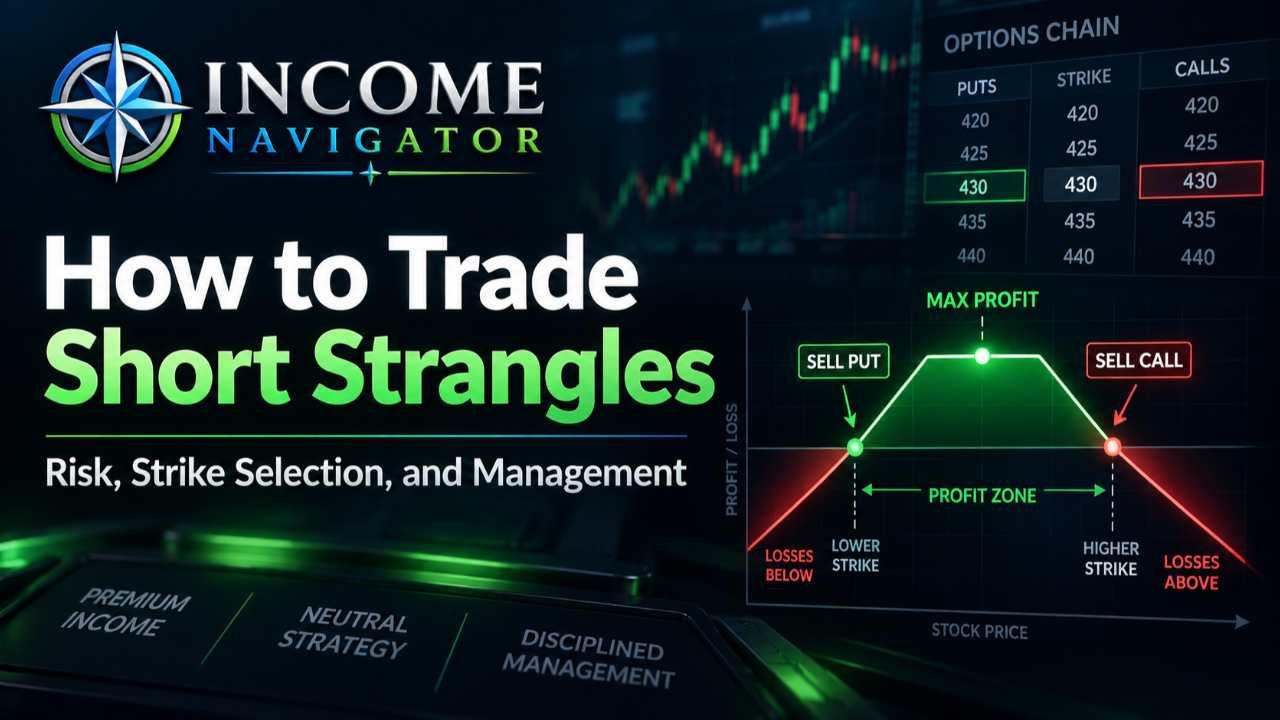
A short strangle can collect premium from both sides of an options market, but it also creates risk on both sides of the underlying price.
You sell an out-of-the-money put.
You sell an out-of-the-money call.
You collect premium from both contracts.
If the underlying stays between the two strike prices, the position may benefit from time decay.
That sounds like a flexible way to trade a market without predicting whether it will move higher or lower.
But a short strangle is not a neutral trade without risk.
It is a premium-selling position with two obligations.
The short put can create a stock-purchase or futures-assignment obligation if the underlying falls.
The short call can create significant risk if the underlying rises sharply.
And in futures options, the position can involve additional contract-specific risks, margin changes, delivery specifications, and large notional exposure.
When the strikes, expiration, buying-power requirement, and maximum loss plan fit the portfolio, a short strangle can be a structured premium-selling strategy.
When the trade is entered only because the credit looks attractive, it can create risk that is much larger than the premium received.
What Is a Short Strangle?
A short strangle is created by selling a call option and selling a put option on the same underlying asset.
The call and put have the same expiration date.
But they have different strike prices.
The short put strike is usually below the current underlying price.
The short call strike is usually above the current underlying price.
Both options are generally sold out of the money when the trade is opened.
The trader receives premium from both contracts.
The position may benefit if the underlying remains between the strike prices and the options lose value as expiration approaches.
But the premium received is the maximum possible profit.
The risk can be much larger.
The short put can lose money if the underlying falls below the put strike.
The short call can lose money if the underlying rises above the call strike.
For an uncovered equity short strangle, upside risk on the call side is theoretically unlimited.
For futures options, risk, margin, and assignment mechanics can differ by product and may create substantial exposure.
Example: One short strangle
- Underlying price: $100
- Short put strike: $90
- Short call strike: $110
- Expiration: 45 days away
- Premium collected for the put: $1.50 per share
- Premium collected for the call: $1.50 per share
- Total premium collected: $3.00 per share, or $300 before commissions and fees
If the underlying remains between $90 and $110 at expiration, both options may expire worthless and the seller keeps the premium. If the underlying falls below $90 or rises above $110, one side of the trade begins to create losses. The total credit provides some room, but it does not eliminate the risk of a large move.
📖 Related Reading
Every premium-selling strategy begins with an obligation.
Before selling a call, a put, or both sides of a strangle, understand assignment, strike prices, expiration, and what each short option may require if the market moves against the position.
Read Put Options Explained: Buying & Selling Put Options for Beginners →
Why Traders Use Short Strangles
Traders generally use short strangles when they believe the market may remain within a range through the selected expiration date.
The strategy does not require the underlying to stay completely flat.
The underlying can move higher.
The underlying can move lower.
The trade may still benefit as long as the movement remains contained enough for the combined option premium to decay.
A short strangle can also benefit from a decrease in implied volatility after entry.
When implied volatility falls, option premiums may decline.
That can make it less expensive to close a short strangle.
But the same factors that can create premium opportunity can also create risk.
High implied volatility may reflect earnings risk, macroeconomic uncertainty, central-bank announcements, commodity supply concerns, geopolitical events, or the possibility of a larger-than-normal move.
The larger credit is often compensation for a larger risk.
Short Strangles on Futures
Some traders use short strangles on futures options rather than on individual stocks or ETFs.
Futures options can offer access to products tied to equity indexes, interest rates, currencies, energy, metals, agricultural products, and other markets.
That variety can create different opportunities.
It can also create different risks.
Futures contracts often have substantial notional value.
Small price changes in the underlying futures contract can create meaningful profit-and-loss changes.
Margin requirements can also change as market volatility increases.
And some futures options may result in a futures position if assigned or exercised, depending on the product and contract rules.
Before trading a futures strangle, understand:
- The notional value of the futures contract
- The tick size and dollar value of each tick
- The exchange and broker margin requirements
- How margin may change during higher volatility
- Whether the options are physically settled, cash settled, or result in a futures position
- The final trading date and settlement process
- The liquidity of the specific strike prices and expiration
Futures options are not simply stock options with different symbols.
The product specifications need to be understood before the trade is entered.
Selecting an Underlying
The underlying market comes before the option chain.
That is especially important for short strangles.
A trader may prefer markets with strong liquidity, active options chains, manageable bid-ask spreads, and product behavior they understand.
Some traders may look for markets that have recently traded within a broad range.
Others may avoid entering new short strangles immediately before known events that could create sharp movement.
But a range in the past does not guarantee a range in the future.
Every market can trend.
Every market can gap.
And every market can experience a volatility expansion that changes the trade quickly.
Do not assume a market is safe because it has been calm recently.
Use historical behavior as context, not as a promise.
📖 Related Reading
High premium may reflect market risk rather than a simple income opportunity.
Before selling options in a high-volatility environment, consider whether the market is pricing a real event, trend, liquidity issue, or expected movement that could challenge the position.
Read High IV Options: Why Higher Premium Means Higher Risk →
Strike Selection and Delta
Strike selection determines the range where the short strangle may perform best.
The short put strike establishes the downside level where the put begins to gain intrinsic value.
The short call strike establishes the upside level where the call begins to gain intrinsic value.
Traders often use delta as one input when comparing strikes.
Lower-delta options are generally farther out of the money.
Farther out-of-the-money strikes usually offer less premium.
But they may provide more distance from the current underlying price.
Higher-delta options are generally closer to the current price.
They may offer more premium.
But they also have less room before the position is challenged.
Delta can help compare the tradeoff between premium and distance.
It is not a guarantee that a strike will remain out of the money.
It does not predict unexpected news, market gaps, trend changes, or volatility shocks.
Example: Comparing wider and narrower strikes
Wider short strangle:
- Short put farther below the current price
- Short call farther above the current price
- More room for movement
- Usually less premium collected
Narrower short strangle:
- Short put closer to the current price
- Short call closer to the current price
- Less room for movement
- Usually more premium collected
The higher credit from a narrower strangle does not automatically make it better. It reflects a position with less distance from the current market price and a greater likelihood of becoming challenged if the underlying moves.
📖 Related Reading
Delta can help compare strikes, but it cannot make a short option risk-free.
Use delta as context when choosing option strikes, while keeping volatility, underlying risk, expiration, capital commitment, and position size at the center of the decision.
Expiration and Time Decay
Time decay is one reason traders sell short strangles.
As expiration approaches, out-of-the-money options generally lose time value, all else equal.
That can make it less expensive to close a short strangle.
But time decay is not the only factor affecting the position.
The underlying price can move.
Implied volatility can rise.
Margin requirements can increase.
And a large move can create losses that are much greater than the original premium received.
Choosing an expiration date involves tradeoffs.
A shorter-dated strangle may experience faster time decay.
But the strikes may have less time to recover from a sudden move.
A longer-dated strangle may provide more time for a market to move and revert.
But it may tie up capital longer and remain exposed to more events over the life of the trade.
There is no expiration date that makes a short strangle safe.
The expiration should fit the trading plan, risk budget, liquidity, and management approach.
Understanding the Risk
The maximum profit on a short strangle is limited to the total premium collected.
The risks are not equally limited.
On the put side, the underlying can fall substantially.
On the call side, an uncovered call can create theoretically unlimited risk if the underlying rises without limit.
In practice, brokers may require additional margin or close positions when available buying power becomes insufficient.
That can force a trader to realize a loss during a volatile market move.
For futures options, the notional value and margin dynamics can make these risks more complex.
A short strangle should not be evaluated only by its probability of profit, premium amount, or historical win rate.
It should be evaluated by the size of a realistic adverse move, the capital available to manage the position, and the maximum loss the trader is prepared to accept.
A short strangle can produce many small gains while remaining exposed to a much larger loss during a sharp or sustained market move.
Position Size and Buying Power
Position size is one of the most important decisions in a short strangle strategy.
The initial credit may look small.
The initial buying-power requirement may appear manageable.
But margin requirements can change as the underlying moves or volatility rises.
Multiple short strangles can also create correlated exposure.
For example, positions in related equity-index futures, commodity futures, or currency futures may all move against the portfolio during the same market event.
Before opening a short strangle, consider:
- The maximum loss you are prepared to accept on the position
- The current and potential future buying-power requirement
- The notional value of the underlying
- How the position might react to a large one-day or overnight move
- Whether other open positions are exposed to the same market theme
- Whether the account has sufficient capital to avoid forced decisions during volatility
A trade is not small because the credit is small. A trade is small only when the potential loss and buying-power impact are appropriate relative to the portfolio.
📖 Related Reading
Position size can change both the portfolio risk and the trader’s behavior.
A position that is too large can turn ordinary market movement into an emotional decision, making it harder to follow a planned exit or adjustment process.
Read Position Sizing: How Trade Size Changes Your Psychology →
Planning the Exit Before Entry
A short strangle needs a management plan before it is opened.
That plan may include a profit target.
It may include a maximum loss level.
It may include a decision to reduce risk if one strike is challenged.
It may include closing the position before a known event.
Or it may include a decision to convert the position into a defined-risk structure, depending on the product, liquidity, and trader’s plan.
There is no single adjustment rule that works for every trade.
Rolling a short option does not erase the original loss.
Adding another position does not automatically reduce risk.
And holding through a challenge is not automatically disciplined if the exposure no longer fits the account.
Each management decision should be treated as a new risk decision.
Ask yourself:
Would I open this adjusted position today if I did not already have the original trade?
If the answer is no, the adjustment may not fit the plan.
Defined-Risk Alternatives
Some traders prefer to define the maximum loss of a premium-selling position.
One approach is an iron condor.
An iron condor combines a short put spread and a short call spread rather than selling an uncovered put and call.
The long options cap the risk on each side.
The trade usually collects less premium than an uncovered short strangle.
But the maximum potential loss is known at entry.
That tradeoff may be worth considering for traders who want premium-selling exposure without undefined risk.
Defined risk does not mean no risk.
It means the maximum loss is established before the trade is entered.
Short Strangle Checklist
Before selling a short strangle, ask:
- Do I understand both the short call and short put obligations?
- Am I trading equity options, ETF options, or futures options?
- What is the maximum risk if the market moves sharply higher or lower?
- What is the notional value of the underlying contract?
- What are the current and potential margin requirements?
- Why is implied volatility at its current level?
- What known events could create a large move before expiration?
- How much room do the strikes provide from the current price?
- How does delta help compare the available strikes?
- How liquid are the options I may need to close or adjust?
- What is my planned profit target, maximum loss, and adjustment process?
- How does this trade fit with my total portfolio and correlated positions?
If you cannot answer these questions clearly, the trade may not be ready.
The Bottom Line
A short strangle is a premium-selling strategy that involves selling an out-of-the-money call and an out-of-the-money put with the same expiration.
It can benefit when the underlying remains within a broad enough range and when time decay or falling implied volatility reduces the value of the options.
But the maximum profit is limited to the premium collected.
The losses can be much larger if the market makes a sharp or sustained move.
That risk can be especially significant in futures options because of notional exposure, margin changes, and product-specific assignment mechanics.
Choose the underlying carefully.
Understand the contract specifications.
Select strikes based on more than premium.
Keep position size conservative.
And know how you will exit or manage the position before the market forces the decision.
But the range risk, buying-power requirement, potential obligation, and maximum loss matter more.
Learn to Think Beyond the Trade
At Income Navigator, we do not focus on chasing the highest premium or blindly following trade alerts.
We focus on understanding the structure of the trade, the risk being taken, position sizing, volatility, portfolio exposure, and how each position fits within an overall trading plan.
Inside the Income Navigator community, members can follow real options trades and see the thinking behind entries, adjustments, exits, and risk-management decisions as they happen.
If you want to build a more disciplined approach to options trading instead of simply chasing premium, learn more about Income Navigator here.
Options education, real-world trade management, and a community focused on the process behind the trade.
Options trading involves substantial risk of loss and is not appropriate for all investors. Past performance is not indicative of future results. This content is for educational purposes only and should not be considered investment, legal, or tax advice.
Stay connected with news and updates!
Join our mailing list to receive the latest news and updates from our team.
Don't worry, your information will not be shared.
We hate SPAM. We will never sell your information, for any reason.
